
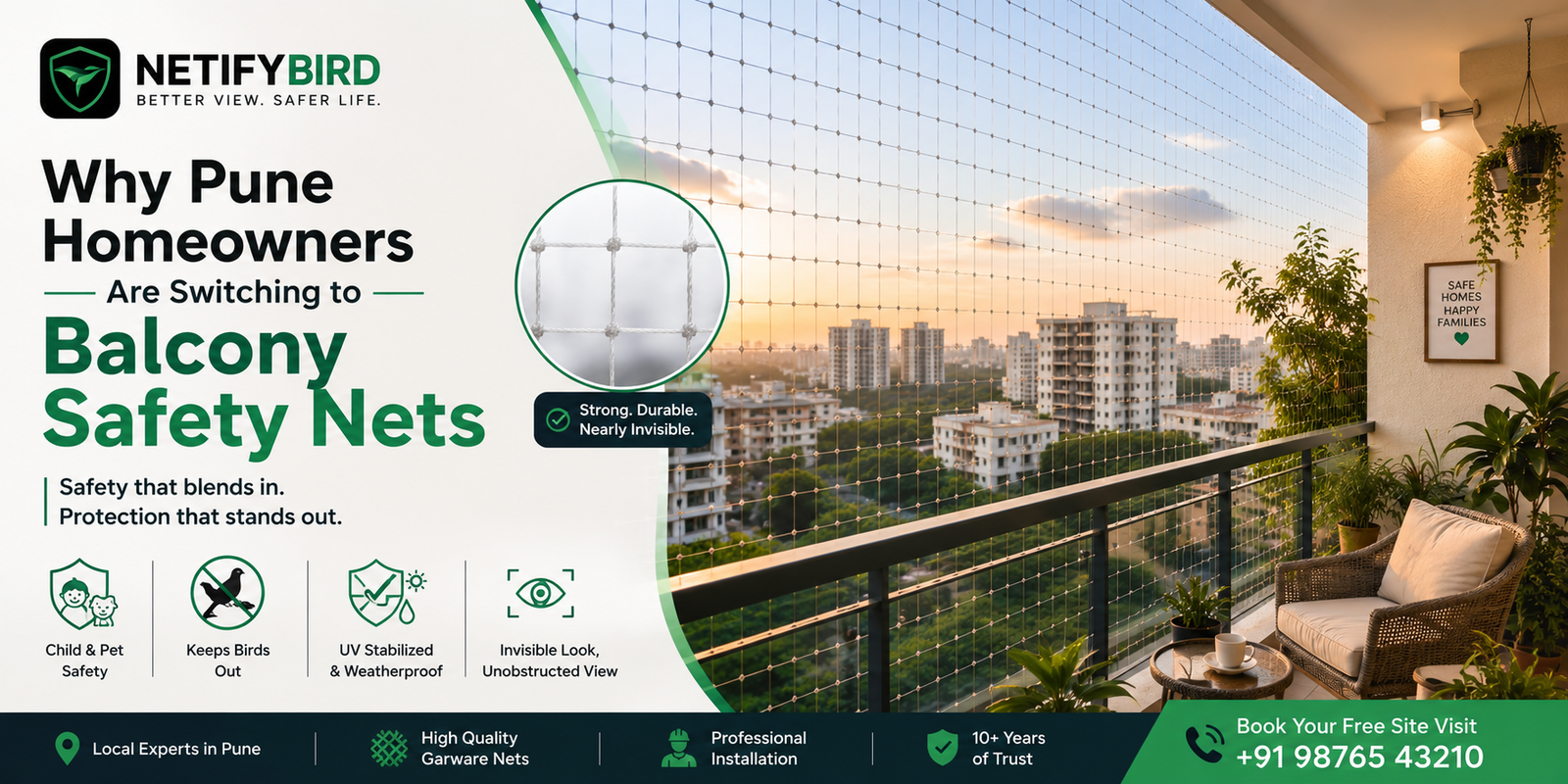
If you’ve walked through any housing society in Pune over the last year, you’ve probably noticed it too — fewer welded iron grills going up on balconies, and a lot more mesh-style safety nets. It’s not just a design trend. It’s a shift driven by real changes in how Pune homeowners think about safety, compliance, and long-term risk.
Under RERA 2.0, the regulatory framework rolled out in 2026, developers are now held to a stronger five-year defect liability period — meaning builders are responsible for fixing genuine structural or workmanship defects that show up after possession, at no cost to the buyer. It’s a big win for homeowners. But it’s also made many Pune residents realise something they hadn’t thought about before: any unauthorised structural change you make to your own balcony, like a permanently welded grill, could complicate your ability to claim that protection later. If a builder or society ever needs to determine whether a defect was caused by construction quality or by an alteration you made yourself, an undocumented, permanent grill doesn’t help your case.
That’s one of the reasons more homeowners across Pune and PCMC are switching to balcony safety nets instead — and it’s worth understanding exactly why.
The Real Reason: Balcony Grills Are Under Scrutiny
This shift isn’t happening in a vacuum. In July 2026, the Bombay High Court stepped in on a case involving an unauthorised balcony enclosure and directed the Maharashtra government to draft clear guidelines on what home alterations require prior approval. The court specifically flagged balcony safety grills, mesh enclosures, and sheds as changes that can affect a building’s approved plan, external appearance, and structural safety — and said such changes often need sign-off from both the housing society and municipal authorities.
For a lot of homeowners, that was a wake-up call. Many had assumed that because they own their flat, they can modify the balcony however they like. In practice, the balcony is part of the building’s shared structure and approved facade — which means societies and municipal bodies do have a say in what goes up there.
This is exactly where a balcony safety net has an advantage a welded grill doesn’t.
Balcony Safety Net vs. Balcony Grill: What’s Actually Different
A traditional balcony grill is a permanent, welded structure. It’s drilled into the wall or floor, becomes part of the building’s exterior, and — as the recent court observations point out — can be treated as an unauthorised structural alteration if it wasn’t approved as part of the original building plan.
A balcony safety net, on the other hand, is fitted using tensioned cords and discreet anchor points. It doesn’t alter the building’s structure, doesn’t change its external appearance, and can be removed or adjusted without any construction work. For societies that are cautious about approving permanent changes — and for homeowners who don’t want to deal with a compliance headache later — that difference matters a lot.
There’s also a simple everyday safety angle. Grills can trap residents inside during a fire or emergency, since they’re rarely designed with quick-release mechanisms. A properly installed net doesn’t create that risk, while still doing the core job: keeping children, pets, and belongings secure on upper-floor balconies.
Why This Matters More in PCMC and Pune Societies
Pune and PCMC have seen a wave of new possessions over the last couple of years as RERA-registered projects reach completion. New homeowners moving into these societies are often the ones asking their society committees the most questions — what’s allowed on the balcony, what needs an NOC, and what could cause trouble down the line.
Housing societies, understandably, are becoming more cautious. Nobody wants to be the society that approved a grill installation only to face a dispute later when the building’s facade or fire-safety compliance is questioned. A balcony safety net sidesteps that entire conversation. It’s non-structural, it’s reversible, and in most cases, it doesn’t require the same level of approval that a permanent grill would.
If you’re a new homeowner in a Pune society, or a committee member fielding these requests, this is worth raising proactively — before a grill goes up and someone has to ask for it to come down.
What to Look for in a Good Balcony Safety Net
Not all nets are built the same, and a poorly installed one defeats the purpose. A few things worth checking:
- UV-stabilised, high-tensile nylon or HDPE material — cheaper nets degrade and sag within a year or two in Pune’s sun and monsoon cycle.
- Discreet, non-invasive anchoring — good installers use minimal drilling and avoid damaging the building’s facade or waterproofing.
- Proper tension and mesh size — the net should be taut enough to hold weight safely, with a mesh size small enough to stop a child’s hand or a pet from squeezing through.
- A visit-based quote, not a generic price — every balcony is a different shape and height, so a fair quote should follow an actual site visit, not a flat online rate.
This is also where pigeon net installation often comes up in the same conversation. Many Pune balconies need both — a safety net for people and pets, and a pigeon net to stop birds from nesting and leaving droppings behind. When both are installed together by the same team, it’s usually more cost-effective and results in a cleaner, more consistent finish than doing them separately.
Making the Switch the Right Way
If you’re currently considering a balcony grill, it’s worth pausing and asking your society what its current stance is — especially given how active this topic has become since the Bombay High Court’s directive. If you already have a grill and are wondering whether it’s compliant, a quick conversation with your society secretary or a local net installer can usually clarify where you stand.
For homeowners who’ve decided to make the switch to a balcony safety net, the process is refreshingly simple: a site visit to measure the balcony, a quick discussion of mesh type and anchoring points, and installation that typically wraps up in a few hours — no drilling into structural elements, no facade changes, and no waiting on lengthy society approvals in most cases.
Final Thought
The shift toward balcony safety nets in Pune isn’t just about following a trend — it’s a practical response to two very real developments: a legal system paying closer attention to unauthorised balcony alterations, and a regulatory environment under RERA 2.0 that rewards keeping your home’s original structure intact. A safety net gives you the protection you actually need, without the compliance risk that comes with a permanent grill.
If you’re weighing your options for your balcony, our team can walk you through what works best for your specific building and society — including combined balcony safety net and pigeon protection setups. You can also read more about how we approach balcony safety versus other bird control methods in our related guide.
Ready to get a proper site visit and a clear, no-pressure quote? Contact our team today and we’ll help you figure out the right, compliant setup for your balcony.
Frequently Asked Questions
Yes, in most cases. A balcony safety net is a non-structural, removable installation, so it typically doesn’t require the same municipal or society approval that a permanent balcony grill would. That said, it’s always a good idea to inform your society before installation, especially given the increased scrutiny on balcony alterations following the Bombay High Court’s July 2026 directive.
A balcony grill is a permanent, welded structure fixed into the wall or floor, while a balcony safety net is fitted using tensioned cords and discreet anchor points. The net can be removed or adjusted without construction work, doesn’t affect the building’s approved plan, and avoids the compliance risks associated with permanent alterations.
It can complicate things. Under RERA 2.0’s five-year defect liability period, developers are responsible for genuine structural or workmanship defects. If a permanent, unauthorised alteration like a welded grill is present, it can make it harder to establish whether a defect was caused by construction quality or by the alteration itself. A balcony safety net avoids this ambiguity since it doesn’t touch the building’s structure.
Most installations are completed within a few hours, depending on the balcony’s size and shape. The process usually starts with a free site visit to take measurements, followed by installation using minimal drilling and no structural changes.
Yes, and it’s usually more practical to do so. Combining balcony safety net and pigeon net installation in a single visit is typically more cost-effective and results in a cleaner, more consistent finish than installing them separately at different times.