
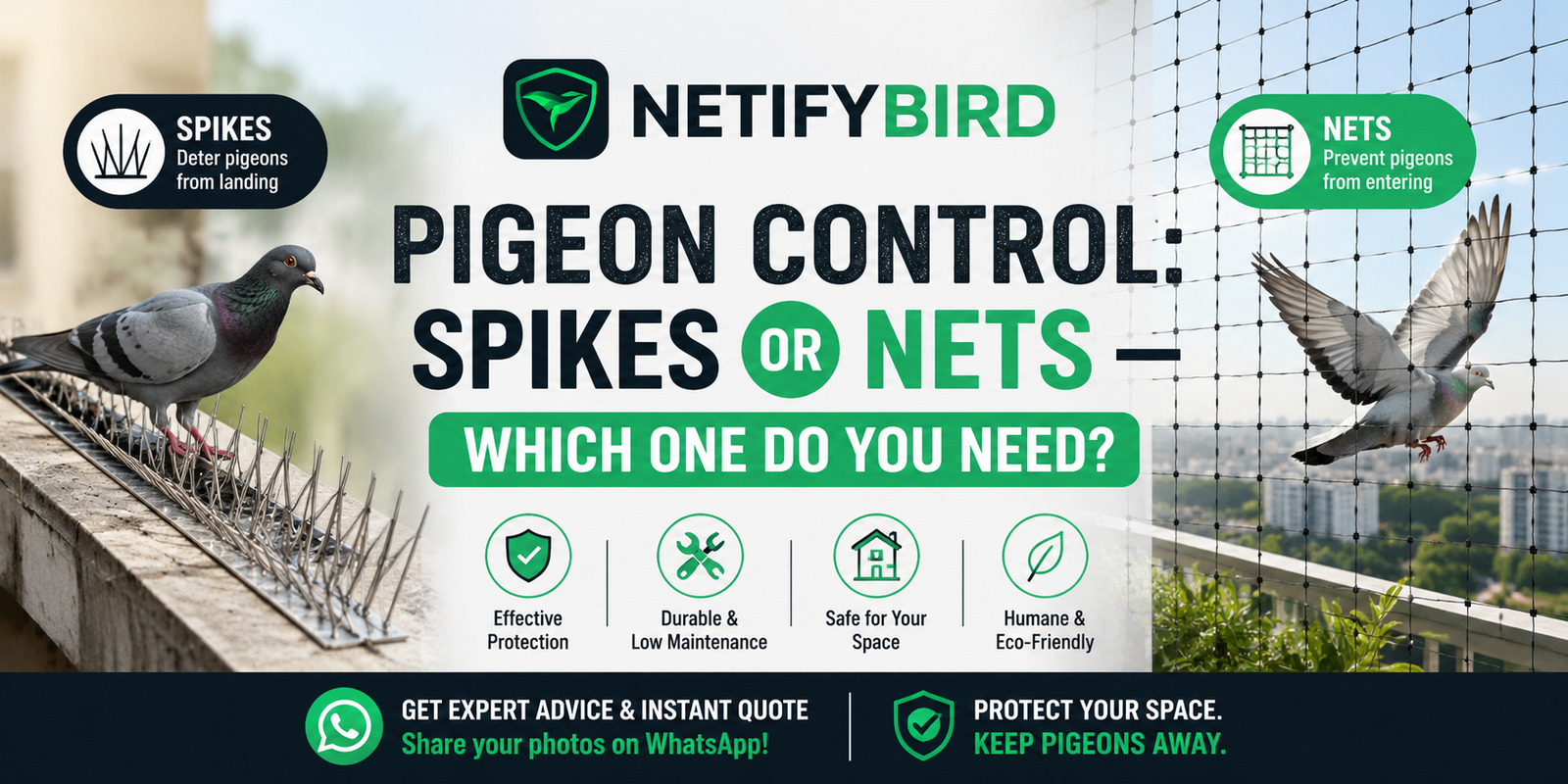
If pigeons have started showing up on your balcony, window ledge, or terrace, you’ve probably already searched for a fix — and quickly landed on two options: spikes or nets. Both work. Both are humane. But they’re built for different problems, and picking the wrong one usually means spending money twice.
This guide breaks down how each method actually works, where each one makes sense, and how to figure out which fits your specific space.
Why Pigeon Control Matters More Than It Seems
Pigeon droppings aren’t just an eyesore. They carry fungal spores that can trigger respiratory issues, corrode paint and metal railings over time, and once a pair starts nesting, they tend to return to the same spot year after year. What starts as “a few pigeons landing on the ledge” often turns into a recurring cleaning problem within a few months if it’s left alone.
The good news is that both spikes and netting solve this permanently, without harming the birds. The real question isn’t which one is “better” in general — it’s which one matches the shape and size of your space.
How Bird Spikes Work
Bird spikes are rows of blunt, closely spaced prongs fixed directly onto a ledge, sill, or railing. They don’t hurt pigeons at all — they simply make the surface too uneven and unstable for a bird to comfortably land or perch on. Faced with a spiked ledge, pigeons move on and look for somewhere else to sit.
Spikes are ideal for narrow, linear surfaces:
- Window sills and balcony ledges
- Parapet walls and building cornices
- AC condenser units and exposed pipework
- Signboards, hoardings, and railings
- Solar panel edges, where nesting underneath can damage wiring and reduce panel efficiency
Installation is usually quick — most residential jobs are done within a couple of hours, since spikes only need to cover the specific ledges or edges where birds are landing, not an entire open space.
How Bird Netting Works
Netting takes a different approach. Instead of targeting individual landing spots, it seals off an entire open area — a balcony, terrace, or building facade — with a mesh barrier that physically stops birds from entering the space at all.
This is the better fit when:
- The balcony or terrace is large and open, with plenty of room for a bird to land anywhere in the middle of the space, not just along the edges
- You want complete enclosure, not just deterrence at specific points
- The space is used regularly by family, including children or pets, where full protection matters more than a targeted fix
A standard balcony net installation typically takes two to four hours, while larger terraces or full building facades can take a day or more, depending on scaffolding and access requirements.
Spikes vs. Netting: The Core Difference
Here’s the simplest way to think about it: spikes stop birds from landing on a specific edge. Netting stops birds from entering a space at all.
If your problem is pigeons perching on a window sill, AC unit, or narrow ledge, spikes solve it directly and usually more affordably, since you’re only covering a defined length rather than an entire open area. If your problem is pigeons flying into an open balcony or terrace and roosting anywhere within it, spikes won’t help much — there’s simply too much open surface for point-deterrents to cover. Netting is the only way to seal that off completely.
Some properties genuinely need both — for example, a full balcony net to enclose the main space, plus spikes on an adjoining ledge or AC unit that the netting doesn’t cover. A good installer will tell you honestly when a combination makes more sense than pushing you toward one option.
Cost Considerations
Pricing for both methods depends on similar factors: total area or length to be covered, material choice, building height, and how complex the space is. Bird spikes are generally priced per foot of ledge or sill, while netting is priced by total area. For a small balcony ledge, spikes are usually the more economical choice. For a full open terrace, netting is almost always more cost-effective than trying to spike every possible landing point.
If you’re weighing the numbers more closely, our bird netting cost and process guide covers what typically affects pricing, along with a realistic sense of timelines — worth a read if netting looks like the better fit for your space.
Which One Should You Choose?
Ask yourself these questions before deciding:
Is the space open or enclosed by edges? Open balconies and terraces need netting. Narrow ledges, sills, and signage need spikes.
How many separate spots are pigeons landing on? A single sill or two? Spikes. Multiple spots across a large open area? Netting.
Is this a long-term residence or a shorter-term fix? Both spikes and netting last for years with minimal upkeep, so this rarely changes the decision — but it’s worth confirming with your installer, especially for rental properties.
Do you have solar panels or AC units involved? These often need spikes even if the rest of the balcony gets netted, since panels and condenser units have specific, narrow surfaces that netting doesn’t cover well.
If you’re still unsure after going through these, that’s genuinely common — a lot of properties have a mix of open and narrow surfaces, which is exactly why a site visit matters more than guessing from photos.
Why a Site Visit Beats a Phone Estimate
Neither spikes nor netting should be quoted without someone actually seeing the space. A ledge that looks straightforward in photos might have curves, obstacles, or existing hardware that changes the approach entirely. A proper site visit lets an installer assess the exact surfaces involved, recommend the right method (or combination), and give you a quote based on reality rather than assumptions.
If narrow surfaces like ledges, sills, or signage are your main concern, our bird spike installation service covers everything from material selection to fitting, with a free assessment to confirm spikes are genuinely the right call for your space before you commit.
Final Thoughts
There’s no universally “better” option between spikes and netting — only the one that matches your specific space. Spikes are precise, quick to install, and cost-effective for ledges and narrow surfaces. Netting is the more complete solution for open balconies and terraces where birds need to be kept out entirely, not just off the edges.
The fastest way to know which one you actually need is a free site inspection, where someone can look at your specific ledges, balcony shape, and problem areas before recommending anything.
Frequently Asked Questions
Yes. It’s common to net an open balcony or terrace while adding spikes to an adjoining ledge, signboard, or AC unit that the net doesn’t cover.
Both typically last five to ten years with minimal maintenance when installed properly, though exposure to direct sun and monsoon wind can affect either if lower-quality materials are used.
Yes. Spikes are specifically designed for narrow, uneven surfaces like AC condenser tops and solar panel edges, where netting isn’t practical.
It depends on the space. Spikes are usually cheaper for small, defined areas like a single ledge. Netting is usually more cost-effective for large open balconies or terraces, since spiking every possible landing spot in an open area would take far more material and labour.
The clearest way is a free site visit, where an installer can assess whether your space is more “open” (favoring netting) or made up of specific edges and ledges (favoring spikes) — or whether it needs a combination of both.