
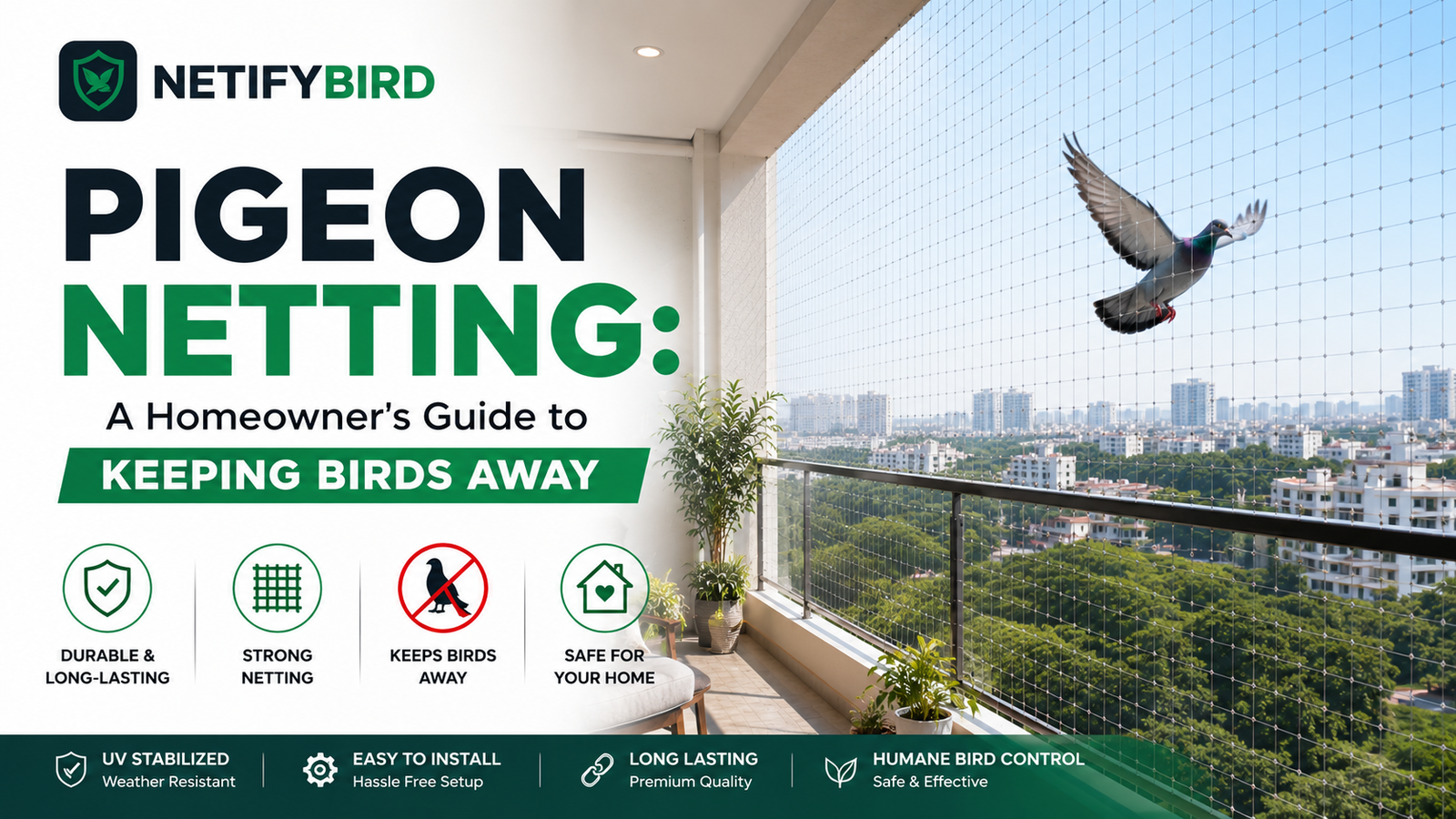
If you’ve ever stepped onto your balcony and found droppings on the railing, feathers stuck in the corners, or a pigeon nest tucked behind your AC unit, you already know how fast the problem gets out of hand. Pigeon netting is the one solution that actually solves this for good, rather than just moving the birds to your neighbour’s ledge for a few weeks.
This guide covers what pigeon netting actually is, how it’s made, where it works best, and what to expect if you’re getting it installed for the first time.
What Is Pigeon Netting, Exactly?
Pigeon netting is a mesh barrier stretched across an open space — a balcony, window, terrace, or building facade — that physically blocks birds from entering. It’s not a chemical, a scare device, or a trap. It’s a straightforward mechanical barrier, and that’s exactly why it works when other methods fail.
Spikes and reflective tape rely on making a space uncomfortable or confusing for birds. Pigeons are smart, and once they realise a spinning CD or a plastic owl isn’t actually dangerous, they go right back to nesting. Netting doesn’t give them that option. If the mesh is properly installed with no gaps, there’s simply no way in.
Why Pigeons Keep Coming Back Without It
Pigeons are creatures of habit, and once a pair claims a ledge or balcony corner as a nesting site, they’ll return to that exact spot season after season. This is part of why half-measures rarely work long term — a pigeon that’s used a balcony for two years isn’t going to be put off by a new smell or noise for more than a few days.
The droppings themselves add urgency to the problem. Pigeon waste is mildly acidic and eats into paint, stains stone flooring, and corrodes exposed metal like railings and AC condenser units over time. There’s also a genuine health angle — pigeon droppings and nesting material can carry fungal spores linked to respiratory issues, which is one more reason most housing societies in Pune now treat netting as standard rather than optional.
How the Mesh Actually Works
Good pigeon netting uses a mesh size small enough to stop even young birds from squeezing through, while staying wide enough to let air and light pass freely. From more than a few feet away, a well-installed net is barely noticeable — you get the view and ventilation without the mess.
Two materials dominate the market:
- Nylon netting is the standard for homes. It’s lightweight, UV-treated to resist Pune’s harsh summer sun, and holds up well through the monsoon without sagging or discolouring.
- HDPE netting is thicker and more heavy-duty, generally used for larger terraces, commercial buildings, or spots with heavier wind exposure.
Both should be knotted at every intersection rather than simply woven, since knotted mesh holds its shape and tension far better over years of exposure.
Where Pigeon Netting Gets Used
Balconies are the most common application by far, but the same principle applies anywhere birds find an open ledge or gap. Terraces, open windows, parking sheds in housing societies, warehouse skylights, and building facades with decorative cornices are all places where pigeons routinely nest if left unprotected. If you’re weighing up options specifically for an apartment balcony, our residential balcony bird netting service covers everything from measurement to installation for exactly this kind of space.
What Installation Actually Involves
A typical residential job starts with a site visit — someone measures the exact space, checks for existing anchor points like grills, and notes any obstacles such as AC units or drainpipes that the net will need to work around. The mesh is then cut to size and secured along the perimeter using hooks, GI wire, or UV-resistant cord, with the installer pulling it taut so there’s no sagging anywhere.
For a standard balcony, this whole process usually wraps up in two to four hours. Larger terraces or full building installations take longer, and can involve scaffolding or rope access depending on the floor height.
What Separates a Good Installation From a Bad One
Material quality matters, but installation quality matters more. A net can be made from premium UV-stabilized nylon and still fail within a year if it’s put up loosely or with visible gaps at the corners.
When you’re evaluating an installer, look for even, consistent tension across the whole net rather than sections that sag or flap. Check that corners and edges are fully sealed with no visible gaps, since these are the exact spots pigeons test first. And pay attention to how carefully the team works around obstacles — drainpipes, sliding door tracks, and AC condensers are where rushed installations most often leave an opening.
What Pigeon Netting Costs
Pricing is generally calculated per square foot, and it depends on a few factors: total area, the mesh material you choose, how high up the installation is, and how complicated the space is. A simple rectangular balcony is quicker and cheaper to net than an L-shaped terrace with multiple corners, railings, and fixtures to work around.
The one thing worth avoiding is a quote given entirely over the phone. Without seeing the actual space, an estimate is a guess, and it often changes once the installer shows up. A proper site inspection gives you an accurate number upfront and avoids surprises on installation day. If you’d like an exact figure for your own balcony or terrace, you can get in touch with our team for a free, no-obligation site visit.
Maintaining Your Net Once It’s Up
One of the underrated advantages of pigeon netting is how little upkeep it needs. An occasional wipe-down to clear dust or cobwebs keeps it looking clean, and it’s worth doing a quick visual check after a heavy monsoon storm to make sure no edges have come loose. If a small tear does show up, it can usually be patched on the spot rather than requiring a full re-installation.
How Long a Good Net Actually Lasts
A properly installed, good-quality net typically holds up for five to eight years in Pune’s climate. UV-stabilized nylon in particular handles the city’s intense summer sun without breaking down, and correct anchoring means the net stays taut through monsoon winds instead of loosening over time. If you’re still deciding between netting and other balcony protection options, our earlier comparison on bird nets versus invisible grills breaks down which one suits different balcony setups.
Mistakes Homeowners Commonly Make
A few patterns show up again and again with netting that fails early. Choosing the cheapest available option without checking whether it’s actually UV-stabilized is the most common one — non-treated netting can go brittle and snap within a single summer. Skipping an in-person site visit in favour of a rough phone quote is another, since it usually means the installer arrives underprepared for the actual space. And simply not checking the corners and edges after installation is finished lets small gaps go unnoticed until pigeons find them.
The Bottom Line
Pigeon netting works because it removes the guesswork entirely — there’s no scare tactic to get used to and no chemical to reapply, just a physical barrier that does its job quietly in the background. Get the material right, get the installation right, and a single netting job can keep your balcony or terrace pigeon-free for years with almost no maintenance in between.
If pigeons have already made themselves comfortable on your balcony, the fastest way to know what it’ll take to fix it is a proper site visit rather than another round of temporary fixes.
Frequently Asked Questions
No. Good-quality netting is made from thin, high-tensile filament that lets through the vast majority of natural light and doesn’t restrict airflow at all. From a normal viewing distance, most people barely notice it’s there.
Not at all. The mesh works purely as a physical barrier that stops birds from entering a space — it doesn’t trap, injure, or harm them. Pigeons simply can’t get through, so they move on and nest elsewhere.
A properly installed, UV-stabilized net typically lasts five to eight years in Pune’s climate. Cheaper, untreated netting can degrade in a single summer, which is why material quality matters as much as installation.
No. Pigeons don’t have the beak strength or jaw structure needed to tear through high-tensile nylon or HDPE mesh. Netting fails almost exclusively due to gaps at corners or poor anchoring, not birds breaking through the material itself.
It’s a one-time installation. Beyond an occasional wipe-down and a quick check after heavy monsoon storms, a well-installed net doesn’t need reinstalling — small tears can usually be patched on the spot rather than requiring a full redo.