
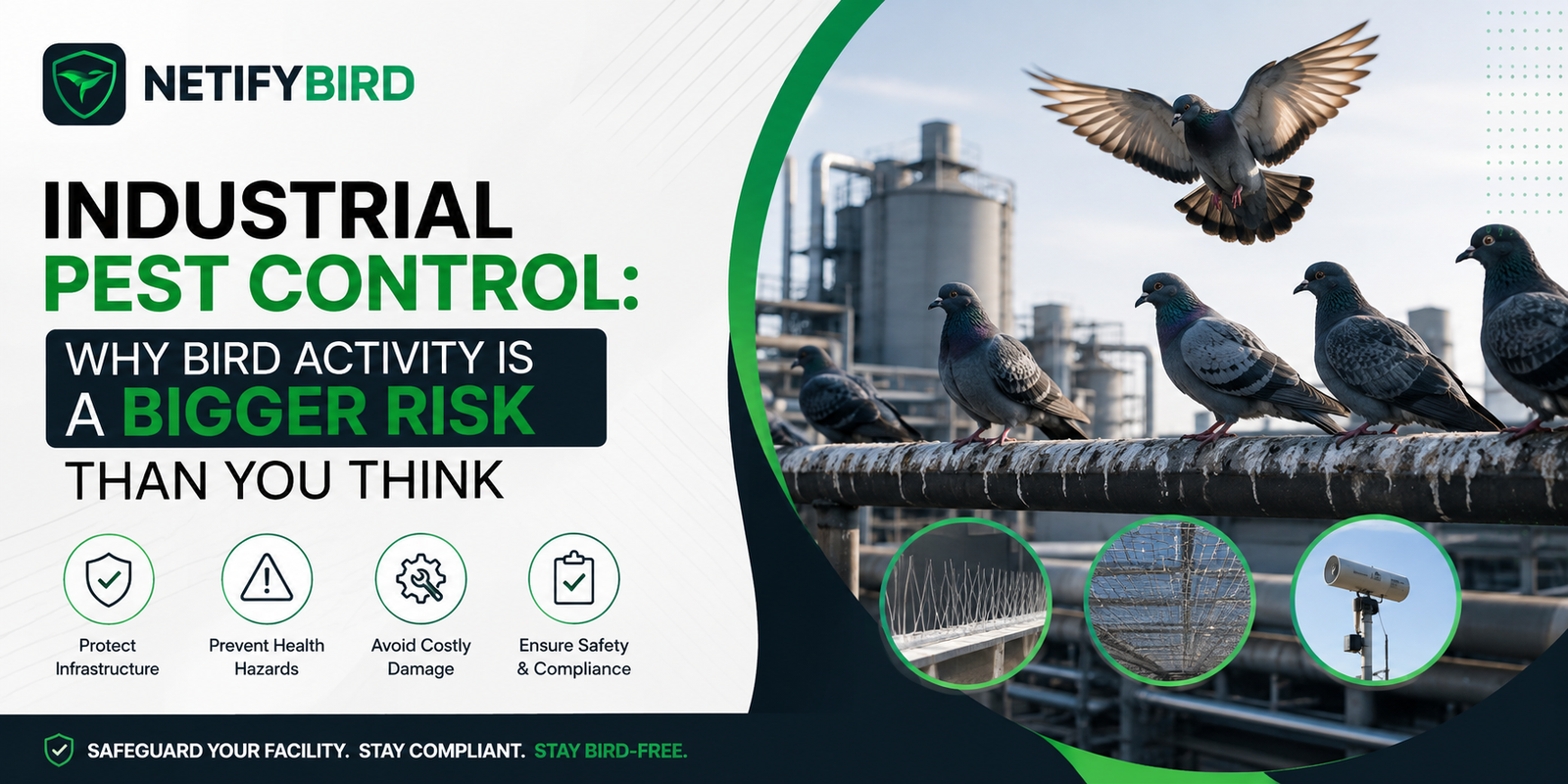
When most facility managers think about industrial pest control, rodents and insects usually come to mind first. Birds, particularly pigeons, tend to get overlooked — they’re seen as a nuisance rather than a genuine operational risk. But in warehouses, factories, and cold storage facilities, uncontrolled bird activity can quietly cause damage that’s far more expensive and far-reaching than most people realize.
If your facility has high rafters, open loading bays, or exposed beams, there’s a good chance birds have already found their way in — even if no one’s flagged it as a priority yet.
Why Birds Are Drawn to Industrial Spaces
Large industrial structures offer almost everything pigeons look for: high, sheltered rafters and beams for nesting, minimal human disturbance in upper areas, and easy access through loading bay openings, broken vents, or gaps in cladding. Unlike a residential balcony, where a single bird or two might be a minor irritation, an industrial facility’s scale means a colony can establish itself in a corner of the building that barely gets noticed during day-to-day operations — until the problems start compounding.
The Real Risks of Ignoring Bird Activity
Contamination risk. Droppings falling onto stored goods, packaging lines, or raw materials can compromise product quality, and in food or pharma facilities, this becomes a genuine hygiene compliance issue rather than just an appearance problem.
Equipment damage. Bird droppings are acidic, and over time they corrode machinery, electrical panels, and structural steel — damage that often isn’t noticed until repair costs are already significant.
Health and safety hazards. Accumulated droppings on walkways, platforms, and stairwells create slip hazards, and droppings themselves carry fungal spores linked to respiratory issues, which is a genuine concern for staff working in or near affected areas.
Fire and wiring risk. Nesting material collecting near electrical wiring or heat sources is a real safety concern, and one that’s easy to miss until an inspection specifically looks for it.
Compliance exposure. For food processing, pharma, and logistics facilities in particular, uncontrolled bird activity can directly affect audit outcomes. A hygiene audit checklist that flags droppings, nesting material, or bird access points can hold up certifications or client approvals that the business depends on.
Why Bird Pest Control Gets Deprioritized
Part of the reason bird activity goes unaddressed for so long is that it’s easy to dismiss as cosmetic — a few droppings on a rafter don’t feel urgent compared to a rodent sighting on the production floor. But bird pest control deserves the same operational seriousness as any other pest category, precisely because the consequences (contamination, equipment corrosion, compliance failures) tend to be slower-building and easier to underestimate until they’ve already caused measurable damage.
Facilities that treat bird exclusion as routine infrastructure, rather than a reactive fix once there’s already a problem, generally end up spending far less over time than those that wait until droppings or nesting material become impossible to ignore.
Cold Storage and Facility Maintenance
Cold storage maintenance in particular tends to focus heavily on temperature control, refrigeration systems, and structural insulation — bird activity rarely makes the checklist, even though loading docks and external bay areas on cold storage facilities are just as attractive to birds as any other warehouse space. The colder internal environment doesn’t deter birds from nesting in external rafters, docks, or eaves, which means cold storage facilities often have the same exposure as any other industrial building, just with an added layer of risk if contamination affects perishable goods.
If bird activity hasn’t been part of your facility’s routine maintenance checks, it’s worth adding — the same way pest control, refrigeration servicing, and structural inspections are treated as scheduled, not optional.
What Industrial Bird Exclusion Actually Involves
Unlike residential fixes, industrial-scale bird exclusion isn’t something that can be handled with standard balcony-net tools or a quick DIY spike strip. It typically requires:
- A full site survey to identify entry points, roosting areas, and existing bird activity across ceilings, beams, and bay openings
- Structural assessment of ceiling height, span width, and access requirements
- Scaffolding, rigging, or lift equipment to safely reach large rafters and high facades
- Custom-measured netting or mesh, since every facility has a different layout of beams, ducting, and machinery
This is a genuinely different scope of work compared to a home or office setup, which is why it needs to be planned and budgeted for as facility infrastructure, not treated as an afterthought once droppings have already become a visible problem. The fundamentals of choosing the right installation team — proper site assessment, experience, and a clear process — matter even more at industrial scale, where the margin for error is higher.
A Growing Priority for Commercial Properties
For property managers overseeing commercial real estate in Pune — warehouses, logistics hubs, and industrial parks — bird activity is increasingly part of tenant satisfaction and lease-readiness conversations, not just a maintenance line item. A facility with visible droppings, nesting debris, or bird noise in loading areas can affect how a space is perceived during inspections or tenant walkthroughs, particularly for food-grade or pharma-grade leased spaces where hygiene standards are non-negotiable.
Building bird exclusion into a facility’s standard upkeep, alongside HVAC servicing, structural checks, and pest control contracts, tends to be a far smaller line item than dealing with contamination claims, compliance failures, or tenant complaints after the fact.
Getting Ahead of the Problem
The most cost-effective time to address bird activity is before it becomes visible — before droppings accumulate, before nesting material builds up near wiring, and before an audit flags it as a non-conformance. If your facility already shows early signs (droppings near loading bays, birds roosting on external ledges, noise from rafters), a proper assessment now is considerably cheaper than remediation later.
Final Thoughts
Bird activity in industrial spaces is easy to underestimate because the damage builds up quietly — a little contamination here, a bit of corrosion there, a compliance flag that could have been avoided. Treating bird pest control as part of routine facility maintenance, rather than a reactive fix, is almost always the more cost-effective path, particularly for cold storage, food-grade, and pharma-adjacent facilities where hygiene compliance carries real operational stakes.
If bird activity has become a recurring issue in your warehouse, factory, or storage facility, our industrial bird netting service covers full-site assessment, structural evaluation, and custom-engineered netting designed for large-scale industrial spaces — built to handle the scale, access requirements, and operational coordination that industrial sites need.
Frequently Asked Questions
The scale is the main factor — industrial spaces have high rafters, open bays, and large areas that are harder to monitor, meaning bird colonies can establish themselves for a long time before becoming visibly obvious. The resulting risks — contamination, equipment corrosion, compliance issues — also tend to be more costly at industrial scale.
Yes. For food processing, pharma, and logistics facilities in particular, an auditor checking a hygiene checklist can flag visible droppings, nesting material, or evidence of bird access as a non-conformance, which can affect certifications or client approvals.
Yes. While internal cold storage areas aren’t attractive to birds, external loading docks, bay areas, and eaves on cold storage facilities are just as exposed as any other warehouse structure, and contamination risk to perishable goods can be higher.
Industrial bird exclusion covers much larger spans, requires scaffolding or lift equipment, and uses heavier-duty mesh built for greater exposure and load. It also needs to be coordinated around ongoing facility operations, unlike a straightforward residential balcony job.
Common early signs include droppings near loading bays or external ledges, visible nesting material in rafters or beams, and bird noise or activity around bay door openings — all worth flagging for a proper site assessment before the issue grows.