
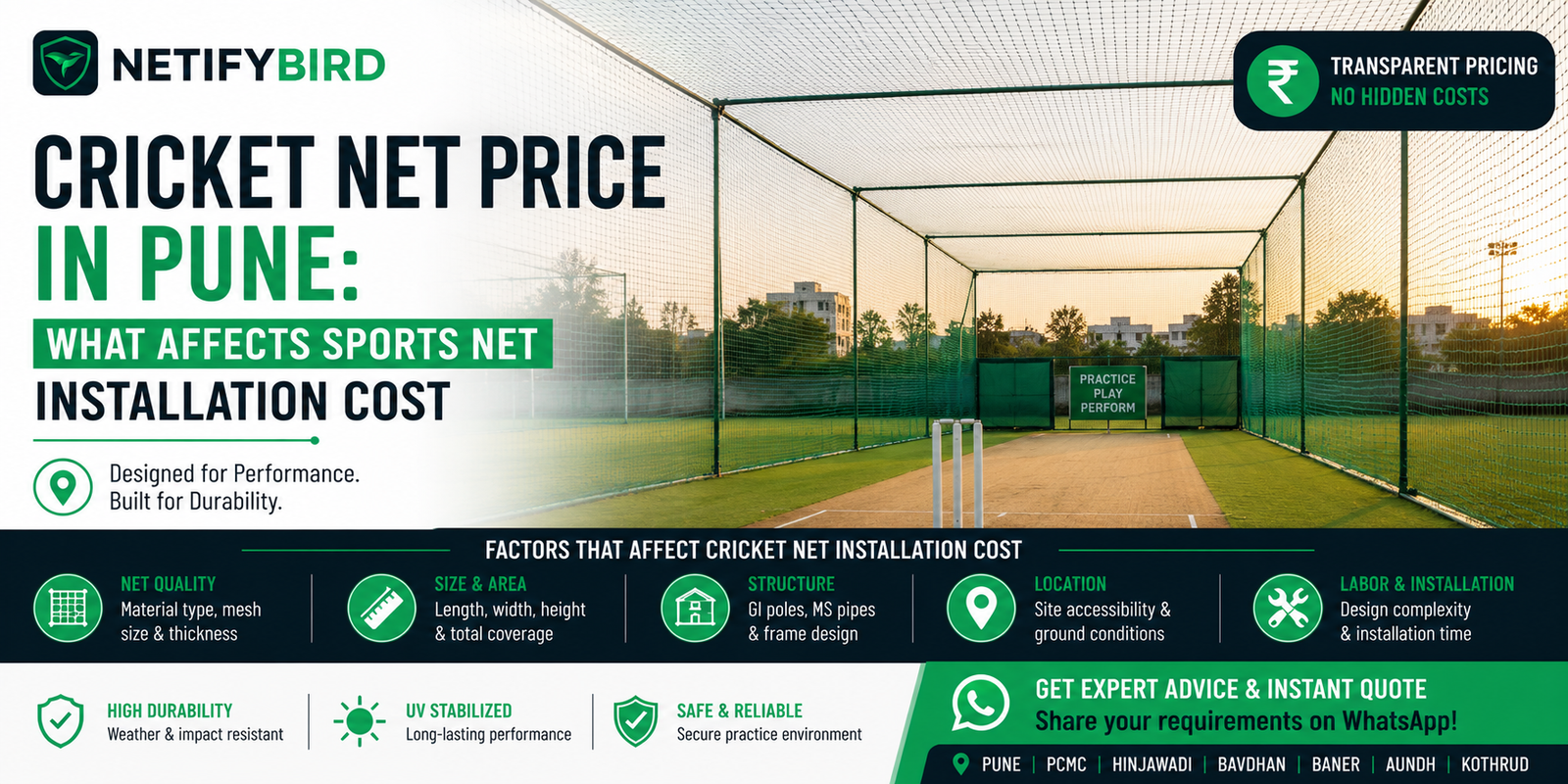
If you’re setting up a cricket practice net on your terrace, in a housing society, or at a school or academy, one of the first questions that comes up is simple: how much will it actually cost? The honest answer is that cricket net price varies quite a bit depending on the space, the material, and how the net will be used — and getting a rough number over the phone rarely reflects what you’ll actually pay once someone sees the site.
This guide breaks down what really drives sports net installation cost in Pune, whether you’re setting up a single cricket net at home or a full multi-sport facility.
Why Cricket Net Price Isn’t a Fixed Number
Unlike a product you can just add to a cart, a cricket net installation depends heavily on the specifics of your space — the dimensions, the anchoring points available, the height of the enclosure, and the quality of netting you choose. Two properties that look similar on paper can end up with very different quotes once a technician actually measures the area and checks what’s involved in anchoring the posts securely.
That’s why most reliable installers, including us, avoid quoting a flat number without a site visit. It’s not a sales tactic — it’s genuinely the only way to give you a price that holds up once the work actually starts.
What Affects Sports Net Installation Cost
- Size of the enclosure. This is usually the single biggest factor. A compact rooftop cricket practice net for one or two players costs considerably less than a full-length net designed for proper bowling run-ups, simply because of the extra material and structural support involved.
- Net material and mesh quality. Most sports nets use high-tensile nylon or braided polyethylene, chosen for UV resistance and the ability to withstand repeated hard-ball impact without sagging. Thicker, higher-tensile mesh costs more upfront but holds up considerably longer under daily use, which often makes it the better long-term value for frequently used practice nets.
- Height and structure. A ground-level enclosure is generally more affordable than a taller structure, since additional posts, cross-bracing, and stronger anchoring are needed to keep taller nets stable under wind and ball impact.
- Anchoring and post work. If a space already has usable structural points — existing poles, wall mounts, or a terrace parapet suitable for anchoring — installation is quicker and costs less than a space that needs fresh post foundations dug and set from scratch.
- Number of sports covered. A single cricket net is naturally cheaper than a combined setup — for example, a facility that wants a cricket practice net alongside a volleyball net or basketball net installation, since each sport has its own sizing, height, and tensioning requirements.
- Location and access. Ground-floor or open-ground installations are typically quicker than rooftop or terrace setups, where material needs to be carried up and anchored around existing structures like water tanks, railings, or parapets.
Typical Cost Ranges by Setup Type
While exact pricing genuinely depends on your site, here’s a general sense of what different setups tend to involve:
- Single rooftop or terrace cricket practice net — the most common residential request, usually completed within a day, with cost driven mainly by enclosure size and anchoring complexity.
- Society or academy-level cricket nets — larger, taller enclosures built for proper practice sessions, often requiring stronger posts and higher-tensile netting to handle daily, heavier use.
- Multi-sport facility setups — combining cricket, volleyball, basketball, football, or badminton court net installations within one facility, priced per net but often more efficient overall than installing each separately over time.
- Industrial and safety net installations — a different category entirely, covering fall protection or debris containment on construction sites, priced based on area and anchoring requirements rather than sport-specific sizing.
Cricket Net vs. Other Sports Net Pricing
Cricket nets tend to sit at the higher end of sports net pricing simply because of the enclosure size and the higher-tensile mesh needed to handle hard-ball impact repeatedly without tearing. A volleyball net or badminton court net installation is usually more affordable, since these involve a single net span rather than a full enclosure. Football goal nets and boundary nets fall somewhere in between, depending on the size of the ground and how much perimeter containment is needed. Golf practice nets, tennis court nets, and playground safety nets each have their own sizing logic, but generally cost less than a full cricket practice enclosure due to the smaller footprint involved.
Why a Site Visit Beats a Phone Quote
It’s tempting to want a number upfront, but sports net installation has too many variables for a phone estimate to be genuinely accurate. A technician needs to see the actual space to assess anchoring options, structural condition, wind exposure (particularly important on rooftops), and any obstacles that might affect how the net is fitted. A proper site visit means the quote you receive actually reflects what you’ll pay, rather than a rough estimate that changes once installation begins.
This same principle applies across other types of netting work too — our detailed breakdown of bird netting cost and installation process in Pune covers similar cost logic if you’re comparing netting projects more broadly, since many of the same factors — area, material, anchoring complexity — apply whether it’s a cricket net or a bird protection net.
Getting an Accurate Quote
If you’re ready to move forward, the most useful thing you can do is have a rough sense of your space (dimensions, intended use, and whether it’s for casual practice or serious daily training) before the site visit. This helps the technician assess material and structural needs quickly, and gives you a clearer, itemized quote rather than a broad range.
Our sports net installation service covers everything from a single rooftop cricket practice net to full multi-sport facility setups, with a free site assessment to give you an accurate cost based on your actual space rather than assumptions.
Final Thoughts
Cricket net price and broader sports net installation cost depend on far more than just the sport — enclosure size, material quality, height, anchoring complexity, and access all play a role. Rather than comparing rough numbers from different providers, the more useful comparison is what each quote actually includes: material quality, anchoring standards, and whether the price accounts for the specific challenges of your space. A free site visit remains the most reliable way to get pricing that won’t change once installation begins.
Frequently Asked Questions
Cricket net price depends on the enclosure size, mesh material, height, and anchoring complexity. A free site visit gives the most accurate quote, since pricing over the phone rarely accounts for the specific structural work involved.
Generally, yes. Cricket nets require a full enclosure with higher-tensile mesh to handle hard-ball impact, which typically costs more than a single net span like a volleyball or badminton court net.
Yes. Taller enclosures need stronger posts, additional cross-bracing, and more secure anchoring to remain stable, which adds to both material and labour cost compared to a lower, ground-level setup.
Often, yes. If your space already has usable anchoring points, like a terrace parapet or existing poles, installation is typically quicker and more affordable than a site needing fresh post foundations.
A standard residential or society cricket practice net is usually completed within a day. Larger academy or multi-sport facility installations can take longer depending on the number of nets and site conditions.