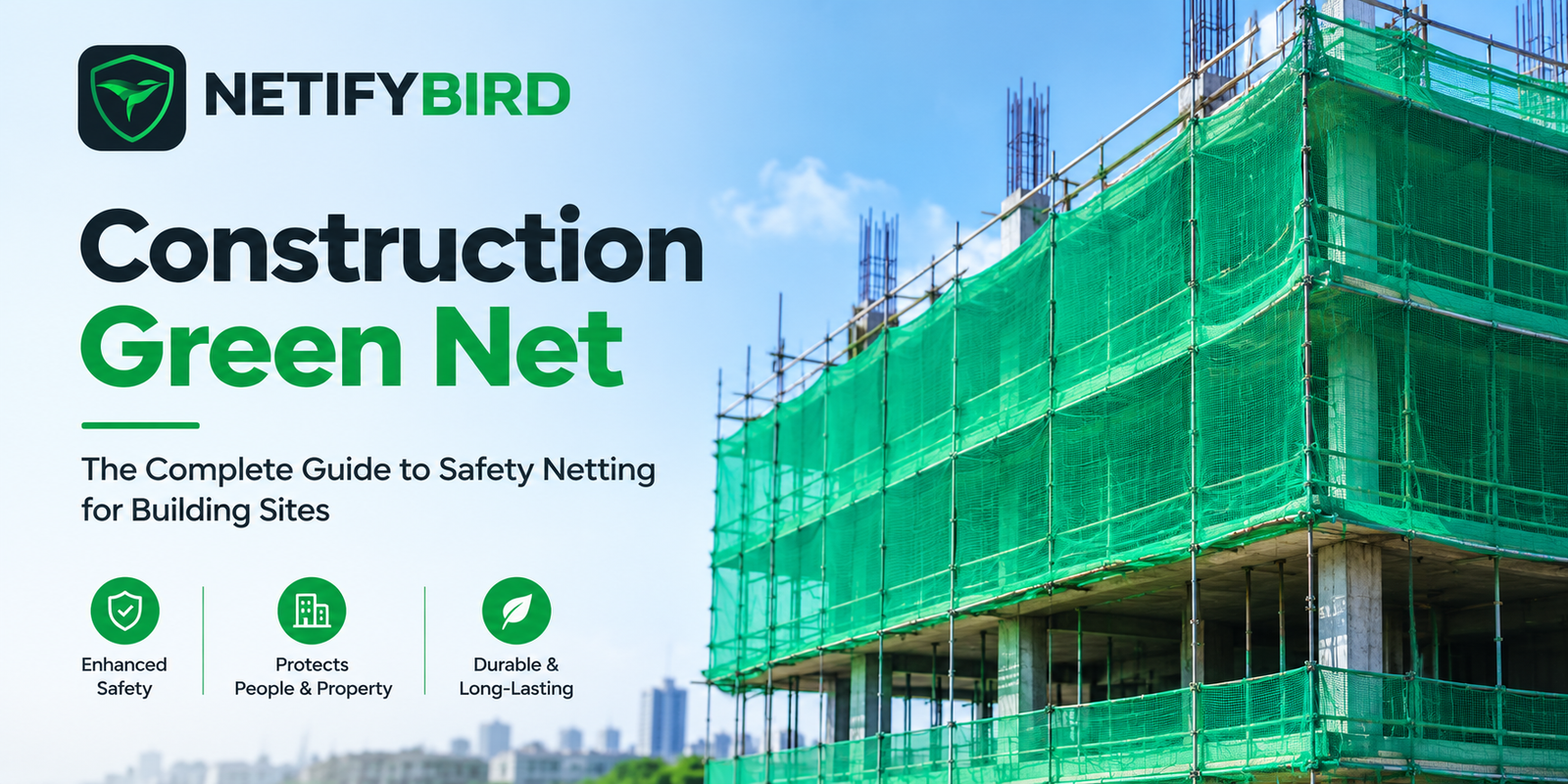
Walk past almost any under-construction building in Pune and PCMC today, and you’ll notice the same thing wrapped around the scaffolding — a green mesh net covering the exterior from floor to floor. This is construction green net, also known as a construction safety net or scaffolding safety net, and it has quietly become one of the most important safety materials on Indian job sites. Yet many builders and housing societies still treat it as an afterthought rather than a mandatory safety investment.
In this guide, we’ll break down what green construction netting actually is, why it matters for construction safety and compliance, and what to look for when choosing the right safety net for construction site use.
What Is Green Net Used in Construction?
Green construction netting — also called a construction safety net or scaffolding net — is a high-density polyethylene (HDPE) mesh fabric installed around the exterior of a building under construction. It’s typically fixed to scaffolding using eyelets, ropes, or cable ties, wrapping the structure vertically from one floor to the next.
The core job of this netting is simple: contain anything that falls off the building — tools, debris, dust, paint chips, loose plaster — before it reaches the ground, pedestrians, parked vehicles, or neighbouring properties. The mesh is fine enough to stop small debris but open enough to let air and light through, which keeps wind load on the scaffolding manageable and keeps the site ventilated for workers.
Why Construction Sites Can’t Skip It
1. Worker and public safety Falling objects from height are one of the most common causes of injury on Indian construction sites. Debris netting acts as a physical barrier, catching dropped materials before they hit someone below — whether that’s a labourer on a lower floor, a delivery worker, or a pedestrian on the street outside.
2. Dust and pollution control Pune’s construction boom has come with rising concern over construction dust and its contribution to air quality problems. Green netting significantly reduces the amount of fine dust and debris that escapes a site into the surrounding air, which matters both for regulatory compliance and for keeping neighbours (and their balconies, cars, and laundry) dust-free.
3. Protecting neighbouring property In dense urban pockets — a common site condition across Pune and PCMC — buildings under construction often sit metres away from existing homes and shops. Without netting, chipped paint, cement dust, and small tools regularly end up on neighbouring balconies or vehicles, leading to disputes and complaints. A properly installed green net prevents this entirely.
4. Weather and wind protection for the site Beyond debris, the netting reduces wind loading on scaffolding structures and offers some shielding from sun and rain for workers operating at height — making it easier to keep work moving safely through Pune’s monsoon and summer months.
5. Regulatory and insurance requirements Many municipal corporations and RERA-registered projects now expect visible safety measures, including debris containment, as a baseline requirement on active sites, in line with the safety provisions laid out under the National Building Code of India. Having proper netting installed also strengthens a contractor’s position with site insurance and liability coverage.
6. Protecting stored materials on site It’s not just people and pedestrians that benefit — cement, wood, and other stored materials on an active site are also exposed to sun and monsoon rain. A well-installed green net cuts down on direct sun and rain exposure for materials stacked near the perimeter, reducing spoilage and rework.
Materials and Specifications to Look For in Construction Safety Nets
Not all construction safety nets are built the same. When sourcing a scaffolding safety net for a project, a few specifications matter:
- Material: HDPE monofilament is the standard — durable, UV-stabilised, and resistant to fraying when cut.
- Mesh density (GSM): This is the main lever for matching net to job. A tighter weave / higher GSM suits heavy-duty zones like demolition or high-rise perimeters, while a lighter weave is enough for general dust screening on smaller sites.
- Edge reinforcement: Look for eyeleted borders — they make installation with ropes or cable ties far more secure and reduce tearing at fixing points.
- UV stabilisation: Pune sees intense sun for most of the year; a genuinely UV-stabilised HDPE net typically holds up for 2 to 5 years of continuous outdoor exposure before it turns brittle, versus a fraction of that for uncoated material.
- Debris nets vs. fall-protection nets: This distinction matters and is easy to miss. Debris containment netting is a lightweight, passive barrier for catching falling material and dust — it is not a substitute for knotless personnel fall-arrest netting, which is a separate, load-rated safety system for protecting workers from falls at height. Don’t let a supplier or site team conflate the two.
Green Net vs. Bird Netting: What’s the Difference?
It’s a fair question, since both are mesh products used on buildings. Debris netting is a temporary, construction-phase product focused on containing falling material and dust — it comes down once construction finishes. Bird netting, by contrast, is a permanent installation designed to keep pigeons and other birds off balconies, ledges, and facades long after the building is occupied.
There’s a practical overlap worth knowing about, though: exposed under-construction floors are also prime pigeon nesting spots. Open floor slabs, unfinished parapets, and idle scaffolding give birds easy access to nest and roost, which creates cleanup and health issues before the building is even handed over. Sites that install debris netting thoughtfully — and plan for permanent bird netting on balconies and facades once construction wraps up — avoid dealing with an established pigeon problem on day one of occupancy. If your project already has a bird presence during construction, it’s worth addressing before compounding it after possession.
Choosing the Right Netting Partner
For builders and housing societies in Pune, the best approach is to work with a supplier who understands both the safety-netting requirements of an active construction site and the long-term netting needs of the finished building. NetifyBird’s industrial bird netting services cover exactly this kind of large-scale, project-based installation — from construction-phase netting through to permanent protection after handover. That continuity means fewer vendors to coordinate and a site that stays protected at every stage.
If your project is nearing completion and balconies, ledges, or open terraces are starting to attract birds, it’s worth planning that transition early rather than reacting to a nesting problem later — our bird-proof netting guide walks through what that looks like once construction wraps up.
Have a project that needs both site safety netting and long-term bird protection? Get in touch with NetifyBird for a site-specific quote.
Frequently Asked Questions
Green net is used to contain falling debris, dust, and loose material from a building under construction — protecting workers, pedestrians, vehicles, and neighbouring property. It also reduces wind loading on scaffolding and cuts down on dust escaping the site.
Beyond debris containment, green mesh is used for site screening (privacy and dust control), shading exposed floors from harsh sun, and providing some protection from rain for workers at height. It’s a general-purpose safety and containment layer wrapped around active construction zones.
Pricing varies by GSM, mesh density, and supplier, but HDPE construction safety netting in India typically runs from roughly ₹70 to ₹200 per kg — lighter, lower-GSM nets sit at the lower end, while denser, higher-GSM or braided variants cost more. It’s best to get a quote based on your project’s exact height, exposure, and mesh requirements rather than relying on a flat rate.
This depends on the roll width and GSM you need, since netting is usually priced per kg or per running metre rather than as a flat length rate. A wider, heavier-duty roll will cost noticeably more per metre than a lighter mesh. For an accurate figure, share your site’s height and required width with a supplier for a project-specific quote.
While specific municipal requirements vary by project size and location, debris containment is widely expected as a standard safety practice, and RERA-registered projects are increasingly expected to demonstrate active safety measures, including netting, on site.
A genuinely UV-stabilised HDPE net typically holds up for 2 to 5 years of continuous outdoor exposure before it turns brittle — well beyond the timeline of most single construction projects. Cheaper, uncoated netting degrades much faster under Pune’s sun.
No, and this distinction matters for site safety. Green debris netting is a lightweight, passive barrier designed to catch falling material and dust — it is not load-rated and should never be used as a substitute for knotless personnel fall-arrest netting, which is a separate safety system built to protect workers from falls at height.
Yes, especially on exposed floors and open terraces left idle for weeks at a time. It’s far easier to prevent nesting early with the right netting approach than to deal with an established pigeon colony after the building is handed over.