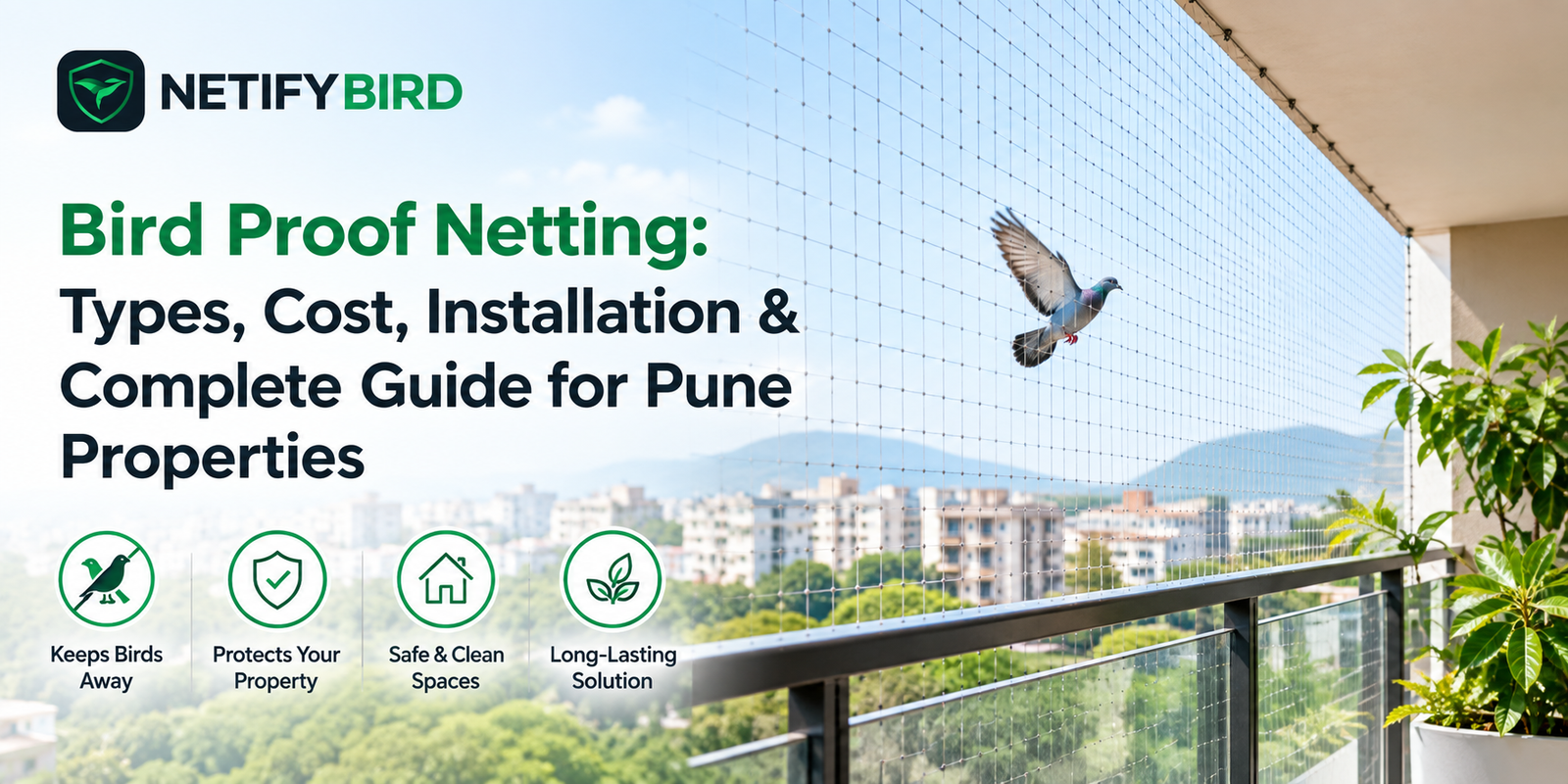
Birds are a normal part of city life, but when they repeatedly enter balconies, ducts, terraces, warehouses or other building spaces, they can quickly become a maintenance problem.
Droppings, feathers, nesting material and repeated cleaning are common concerns for property owners. In some locations, birds may also try to build nests around sheltered corners, equipment or building openings.
For many Pune homeowners and property managers, the practical question is not simply how to remove birds after they arrive. It is how to prevent repeated access to a particular area.
This is where bird proof netting can be useful.
A properly planned bird net acts as a physical barrier between birds and the protected space. Depending on the property, netting can be used for balconies, windows, ducts, terraces, shafts, apartment buildings, solar panels, warehouses, factories and sports facilities.
But buying a net is only one part of the solution. The material, mesh size, fixing method, structure, access requirements and installation quality all need to be considered.
This guide explains the important things to know before installing a bird protection net in Pune.
What Is Bird Proof Netting?
Bird proof netting is a mesh barrier designed to restrict birds from entering a particular area.
Instead of relying on smells, sounds or visual deterrents, netting primarily works through physical exclusion.
Depending on the application, a bird net may be installed across:
- Balconies
- Windows
- Utility areas
- Air-conditioning ducts
- Building shafts
- Terraces
- Housing-society openings
- Parking structures
- Warehouses
- Industrial buildings
- Solar-panel areas
- Sports facilities
The right type of net depends on the location and purpose.
For example, a residential balcony and a large industrial opening may both require bird protection, but their installation requirements can be completely different.
Why Do Pune Properties Need Bird Protection?
Modern buildings often provide birds with sheltered spaces where they can land or attempt to nest.
Balconies, ledges, ducts, terraces and equipment areas can become regular entry points.
Common problems include:
- Bird droppings on floors and walls
- Feathers and nesting debris
- Repeated bird entry
- Nesting in corners
- Dirty balconies
- Frequent cleaning
- Bird activity around AC units
- Debris around equipment
- Birds entering otherwise unused spaces
For an apartment owner, the balcony may be the main concern.
For a housing society, the problem may extend to multiple balconies, ducts, staircases and common areas.
For a factory or warehouse, bird activity may occur across a much larger area.
This is why bird control should begin with identifying where birds are entering and why they are using that space.
How Does Bird Proof Netting Work?
The principle is simple: create a physical barrier that prevents birds from freely entering the protected area.
A professional installation commonly involves the following steps:
1. Site inspection
The area is examined to identify entry points, dimensions, obstacles and potential fixing locations.
2. Measurement
The opening or space is measured so that the net can be planned according to the actual structure.
3. Material selection
The appropriate net material and mesh specification are selected based on the application.
4. Fixing preparation
The installer determines how the net will be secured around the perimeter.
5. Net installation
The net is fitted and secured to the planned fixing points.
6. Tensioning
The net is adjusted so that it sits properly rather than hanging loosely.
7. Final inspection
The installation should be checked for gaps, loose edges and areas that may require adjustment.
The objective is not simply to cover an opening with mesh. It is to create a practical barrier that fits the property.
Types of Bird Proof Netting
There isn’t one bird net that is automatically suitable for every property.
The material, mesh, size and installation method should be selected according to the application.
1. Nylon Bird Netting
Nylon is commonly used for residential bird-netting applications.
It may be considered for:
- Balconies
- Windows
- Small openings
- Residential spaces
However, the quality and specification of the particular product still matter.
Don’t choose a net solely because it is labelled “nylon.” Ask about the actual product specification and whether it is suitable for your location.
2. HDPE Bird Netting
HDPE bird netting is another option used for bird-exclusion applications.
It can be suitable for certain residential, commercial and larger installations depending on the product specification and environment.
Before choosing HDPE, consider:
- Mesh size
- Material specification
- UV exposure
- Installation location
- Fixing method
- Expected maintenance
- Access requirements
The material is important, but it is only one part of the installation.
3. Less-Visible Bird Netting
Some property owners are concerned that a net will affect the appearance of their balcony.
Depending on the material, colour, lighting and viewing angle, some nets may have a lower visual impact than others.
However, it is better to think of these as less visually prominent, rather than assuming that every bird net is completely invisible.
If appearance is important, ask to see the proposed material before installation.
4. Heavy-Duty Bird Netting
Larger commercial and industrial applications may require a more robust netting solution.
These can include:
- Warehouses
- Factories
- Large ducts
- Industrial sheds
- Commercial buildings
- Large terraces
The bigger the protected area, the more important the fixing structure and installation planning become.
For larger properties, industrial bird netting may be more appropriate than a residential-style installation.
Where Can Bird Proof Netting Be Installed?
One of the reasons bird netting is widely used is that it can be adapted to different types of spaces.
Balconies
Balconies are one of the most common residential applications.
A properly installed net can restrict birds from entering the open balcony while allowing residents to continue using the space.
However, the installation should take into account:
- Balcony doors
- Windows
- AC units
- Drainage
- Clothes-drying areas
- Cleaning access
- Balcony shape
If you’re researching balcony-specific options, you can also read this guide on pigeon net for balcony.
Windows and Ducts
Birds can sometimes enter through relatively small building openings.
A suitable net can be used to restrict access while keeping the opening functional where required.
Ducts require additional care because maintenance access may still be necessary.
Terraces and Building Shafts
Large openings and shafts can require perimeter fixing around several sides.
These installations should be planned around:
- Access
- Drainage
- Existing structures
- Maintenance
- Net tension
- Installation height
Housing Societies
A society may have several different bird-related problem areas:
- Balconies
- Staircase openings
- Service ducts
- Terraces
- Common areas
- Parking structures
The solution should consider not only bird control but also how residents and maintenance staff use these spaces.
Bird Proof Netting for Apartments
Apartment buildings require careful planning because the available space is usually limited and several fixtures may already be present.
Before installing a pigeon net for apartments, check:
- Balcony dimensions
- Railing design
- Slab position
- Window movement
- AC units
- Drainage points
- Electrical fixtures
- Cleaning access
- Future maintenance
A net that looks suitable in an online photograph may not necessarily fit the geometry of your balcony.
This is why a site assessment can be more useful than choosing a product based only on price.
For broader residential requirements, you can explore balcony safety.
Bird Netting for High-Rise Buildings
High-rise properties require additional attention because access, height and wind exposure can be different from a low-floor installation.
Before installation, consider:
- Height of the balcony or opening
- Access for installers
- Fixing locations
- Wind exposure
- Net tension
- Maintenance access
- Nearby building structures
A high-rise installation should be approached as a site-specific job rather than simply multiplying the balcony size by a standard rate.
Bird Protection for Solar Panels
Solar panels can create sheltered areas where birds may attempt to nest underneath or around the panel edges.
A dedicated protection system can restrict access while allowing the panels to remain available for inspection and maintenance.
The installation needs to be planned around the panel arrangement and should not unnecessarily interfere with access.
For this specific application, see solar panel protection.
Bird Netting for Industrial and Commercial Properties
Industrial buildings often have much larger openings than residential properties.
Factories and warehouses may have:
- High ceilings
- Large ventilation openings
- Roof structures
- Storage areas
- Loading areas
- Production spaces
- Equipment areas
These environments may require a different approach to residential bird netting.
The installer needs to consider the size of the area, fixing structure, access equipment and how the property operates on a daily basis.
For these requirements, see industrial bird netting.
Bird Netting for Sports Facilities
Sports facilities have their own netting requirements.
A net around a cricket practice area, for example, needs to account for ball impact, player movement, visibility and the dimensions of the playing space.
Sports netting should therefore not automatically be treated as the same product or installation as residential bird netting.
For sports-related requirements, see sports netting.
How Much Does Bird Proof Netting Cost in Pune?
There is no single price that applies to every bird-proofing project.
The final cost can depend on several factors.
| Factor | Why it affects cost |
| Area size | Larger areas require more material |
| Net material | Different materials and specifications vary in price |
| Mesh size | The required mesh depends on the application |
| Fixing system | More complex fixing can require additional components |
| Installation height | Difficult or high-level access can increase installation complexity |
| Shape of opening | Irregular areas can require more planning |
| Number of openings | Multiple separate areas require additional work |
| Existing structure | Fixing possibilities vary from site to site |
| Access requirements | Difficult-to-reach areas may require additional planning |
When comparing quotations, don’t look only at the final number.
Ask what the quotation includes.
Two quotations can have different prices because they use different materials, fixing systems or scopes of work.
What Should You Ask Before Buying Bird Netting?
Before approving an installation, ask a few simple questions.
What material is being used?
Ask for the actual material specification rather than relying only on words such as “premium” or “best.”
What mesh size is recommended?
The mesh should suit the intended application.
How will the net be fixed?
The fixing method should be appropriate for the building structure.
Will I still have access?
Check access to:
- Windows
- AC units
- Drainage
- Electrical equipment
- Solar panels
- Cleaning areas
Can it be removed later?
This can be important for rented apartments or properties that may undergo renovation.
Is there an existing nest?
If birds are already nesting in the area, don’t simply seal the opening without first assessing the situation.
Bird Netting vs Bird Spikes
Bird netting and bird spikes solve different types of bird problems.
Bird netting
Netting is generally considered when the goal is to restrict access to an entire open space.
Examples include:
- Balconies
- Ducts
- Shafts
- Terraces
- Solar-panel areas
Bird spikes
Spikes are generally more appropriate for landing surfaces and ledges.
Examples include:
- Parapets
- Narrow ledges
- AC outdoor-unit ledges
- Building projections
If your problem is a landing surface rather than an open area, you may want to consider bird spikes.
Bird Netting vs Invisible Grills
These solutions have different primary purposes.
Bird netting is mainly used to restrict bird access.
Invisible grills are generally considered for balcony safety and fall protection.
So before comparing the two, identify the actual requirement.
Ask yourself:
Do I need bird exclusion, fall protection, or a combination of requirements?
For a more detailed comparison, you can read bird net vs invisible grill.
Common Bird Netting Installation Mistakes
Even a suitable net can create problems if the installation is poorly planned.
1. Leaving gaps
Small gaps around corners, fixtures or edges can undermine the intended barrier.
2. Poor tensioning
A loose net can look untidy and may not sit as intended.
3. Blocking maintenance access
A net should not unnecessarily make it difficult to service an AC unit, clean a window or access equipment.
4. Choosing only by price
The cheapest quotation may not include the same material or fixing method as a more detailed quotation.
5. Using the same solution everywhere
A residential balcony, factory and solar-panel system have different requirements.
6. Ignoring the existing structure
The fixing method needs to work with the actual building rather than an assumed structure.
Does Bird Netting Affect Sunlight and Ventilation?
This is a common concern among homeowners.
The effect depends on factors such as:
- Mesh type
- Mesh size
- Colour
- Installation position
- Balcony structure
- Lighting conditions
- Viewing angle
A well-planned installation should avoid unnecessarily blocking doors, windows or ventilation points.
However, no responsible installer should automatically promise that a net will be completely invisible or have absolutely no visual effect.
If appearance and airflow are important to you, discuss these points before installation.
How Long Does Bird Netting Last?
The lifespan of bird netting depends on the product, installation and environment.
Factors can include:
- Material quality
- UV exposure
- Weather
- Installation quality
- Tension
- Physical damage
- Maintenance
- Location
A balcony protected from some weather conditions can experience different wear from a net installed on an exposed rooftop or industrial structure.
Regularly inspect the net for:
- Damaged mesh
- Loose edges
- Sagging
- Broken fixing points
- New gaps
- Accumulated debris
Bird Netting Maintenance Checklist
Bird netting is not something that should simply be installed and forgotten.
A basic inspection can help identify problems early.
Check the edges
Look for loose or separated sections.
Check the mesh
Look for tears, cuts or damaged areas.
Check the fixing points
Make sure the net remains properly secured.
Check for sagging
A significant change in tension may indicate an issue.
Check for debris
Remove accumulated leaves or other material where appropriate.
Check after severe weather
Strong weather can place additional stress on outdoor installations.
Can Bird Netting Be Removed Later?
In many installations, removal or adjustment is possible, but the process depends on the fixing system.
This should be discussed before installation if you:
- Rent your home
- Expect renovation work
- Need regular access to equipment
- Plan to modify your balcony
- Expect building maintenance
If future removal matters to you, make it part of the original discussion.
How to Choose the Right Bird Netting Company in Pune
Choosing an installer is about more than finding the lowest quotation.
A good starting point is to look for someone who can clearly explain:
The material
You should know what type of net is being proposed.
The mesh
The mesh should be appropriate for the intended purpose.
The fixing method
The installer should explain how the net will be secured.
The installation process
You should understand what work will actually be carried out.
Maintenance access
Windows, AC units, drainage and other important areas should remain practical to access.
Limitations
Be cautious about unrealistic claims such as “completely invisible,” “maintenance-free” or “works for every situation.”
For a broader look at available solutions, visit NetifyBird.
A Simple Bird Proof Netting Checklist
Before installing a bird protection net, ask:
1. What problem am I trying to solve?
Bird entry, nesting, landing or repeated use of a particular space?
2. Where are the entry points?
Identify the actual areas birds are using.
3. What material is appropriate?
Choose according to the location and application.
4. What mesh is required?
Don’t select solely on appearance.
5. Where will the net be fixed?
The structure and fixing points matter.
6. Can I still access the area?
Think about cleaning, AC servicing, drainage and other maintenance.
7. Can the installation be removed later?
Important for rented homes and future renovation.
8. Is there an existing nest?
Assess the situation before sealing an occupied nesting area.
Which Bird Protection Solution Is Right for Your Property?
The right solution depends on the actual problem.
Apartment balcony
A properly planned bird net may be suitable for restricting bird entry.
Narrow ledge
Bird spikes may be more practical where birds are mainly landing.
Solar panels
A dedicated solar-panel bird protection system can address access around the panels.
Factory or warehouse
A larger industrial installation may be required.
Sports facility
Sports netting needs to be designed around the activity and playing environment.
The important point is that bird protection is not a one-product-fits-all solution.
Why Professional Installation Matters
Bird netting may appear simple when viewed as a product, but installation involves the building itself.
A professional assessment can identify:
- Irregular openings
- Difficult fixing points
- Existing fixtures
- Drainage requirements
- Maintenance access
- High-rise access
- Wind exposure
- Potential gaps
This becomes especially important for large areas and high-rise installations.
The goal should be more than simply putting a net across an opening. The finished installation should be practical for the property and its everyday use.
Bird Proof Netting for Different Pune Properties
Pune has a wide variety of residential and commercial buildings, so bird-proofing requirements can differ significantly.
A compact apartment balcony may require a relatively straightforward installation.
A housing society may need protection across multiple balconies and common areas.
A factory may require a larger system covering high openings or internal structures.
A solar-panel installation has its own access and maintenance considerations.
This is why the best starting point is usually the specific property and the specific bird problem, rather than a generic product description.
Final Thoughts
Bird proof netting can be a practical option for restricting bird access to balconies, apartment spaces, ducts, terraces, solar-panel areas, warehouses and other properties.
But choosing the right solution isn’t simply about finding the cheapest net.
The important questions are:
- Is the material appropriate?
- Is the mesh suitable?
- Is the fixing method correct?
- Are there gaps?
- Can the area still be maintained?
- Is the installation appropriate for the building?
- Can the net be adjusted or removed if needed?
A good bird-protection solution starts with understanding the property and the actual bird problem.
Whether you need protection for a home, apartment, housing society, commercial property or industrial space, NetifyBird can help you choose a suitable bird protection solution based on your property and requirements. For a clear estimate based on your space, request a free bird netting quote in Pune and get guidance on the suitable net, installation and overall cost.
Frequently Asked Questions
Bird proof netting is a mesh barrier used to restrict birds from entering a protected area. It can be used in residential, commercial and industrial applications.
The terms are often used interchangeably in residential discussions, but bird netting can cover a broader range of applications beyond pigeons and balconies.
There isn’t one universal best net. Material, mesh, location, exposure, structure and installation requirements should all be considered.
Yes. Balconies are a common application, but the installation should account for windows, doors, AC units, drainage and maintenance access.
No. HDPE is one material option, but suitability depends on the specific product and installation environment.
Not necessarily. Visibility depends on material, colour, lighting, viewing angle and the surrounding structure.
A properly designed and installed physical barrier can restrict bird access to the protected area. Gaps or damage can reduce its effectiveness.
The cost depends on the size, material, mesh, fixing system, installation complexity, height and access requirements. A site-specific quotation is more useful than a single generic price.
Depending on the fixing system, it may be possible to remove or adjust the net. Discuss this before installation if future access or renovation is expected.
Don’t simply seal the opening. An existing nest should be assessed before the area is enclosed.