
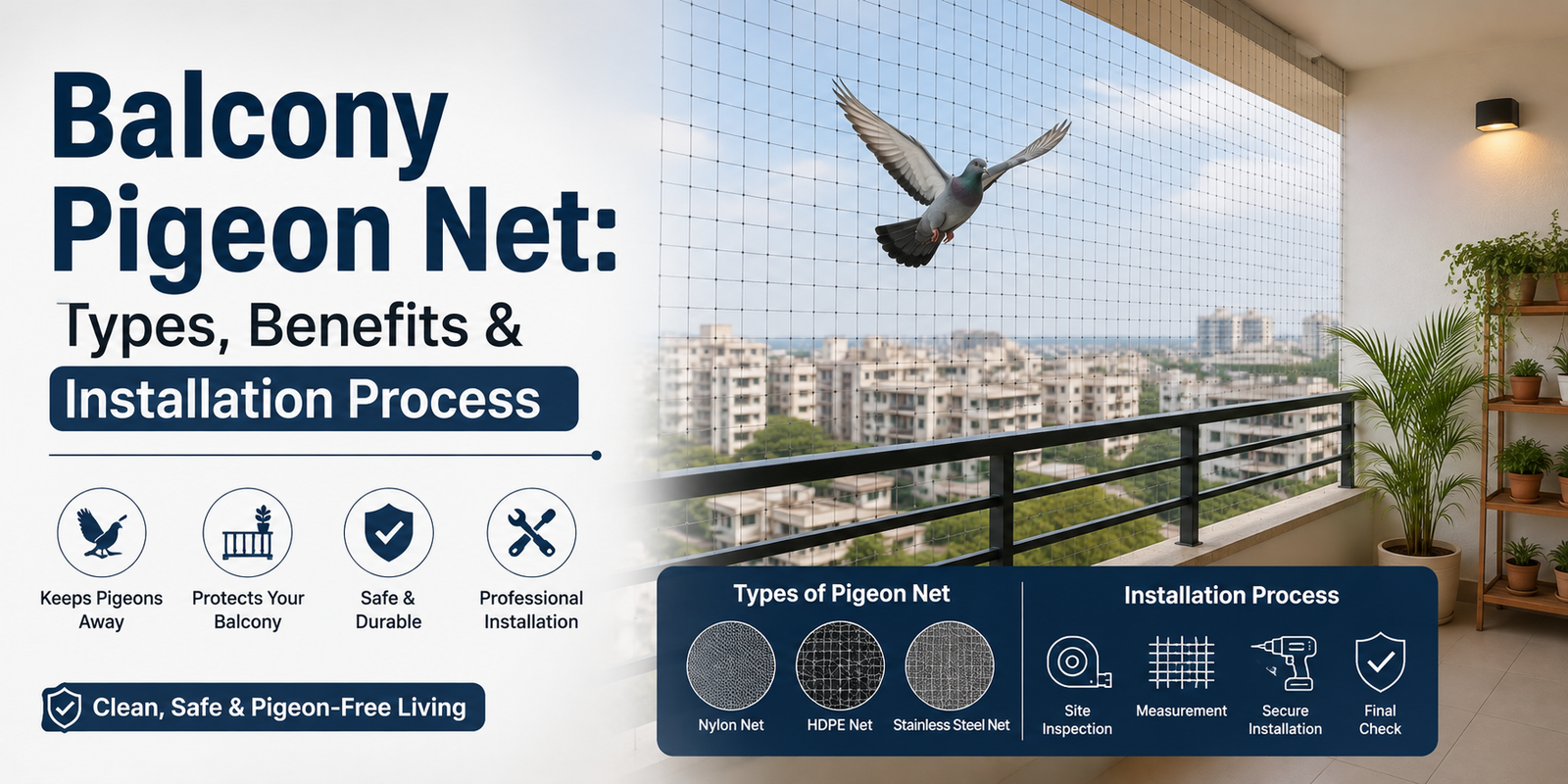
A balcony is meant to be a place to relax, dry clothes, keep plants, or just get some fresh air — not a landing pad for pigeons. A well-chosen balcony pigeon net turns a pigeon-prone balcony back into usable space, and understanding the types available and how installation works helps you make a confident decision.
Why Balconies Attract Pigeons
Balconies offer everything a pigeon looks for: a flat, sheltered ledge, protection from rain and direct sun under the floor above, and proximity to food sources if you have plants, bird feeders nearby, or even just crumbs from outdoor dining. Once a pair nests successfully, they tend to return season after season, and their droppings accumulate quickly, staining floors and railings and creating a genuine hygiene issue. This is exactly why more homeowners are now searching for practical pigeon prevention methods before the problem gets worse.
Types of Bird Net for Balcony Use
Standard nylon mesh nets are the most widely used bird net for balcony protection in residential settings. They are lightweight, nearly transparent from a distance so they don’t obstruct your view much, and durable enough to handle years of sun and monsoon exposure without degrading.
HDPE nets offer more strength and are a good option as a heavier-duty pigeon safety net for larger, more exposed balconies or terraces where wind load is higher.
Mesh size options typically range from 3/4 inch to 2 inch. A tighter mesh (3/4 inch to 1 inch) is better if sparrows or smaller birds are also an issue, or if you want extra assurance for young children or pets.
Color options — most nets come in black, white, or green. Black is the most popular because it blends into shadows and is least visible against most backgrounds, while white or green can be chosen to better match a building’s facade.
Key Benefits of a Pigeon Protection Net
Complete bird exclusion. Unlike spikes or scare devices, a full pigeon protection net physically seals off the balcony, so pigeons cannot enter at all, whether to perch, nest, or feed.
Hygiene and health protection. Pigeon droppings are known to carry fungal spores linked to respiratory conditions. A net eliminates the source of contact entirely, making it one of the more reliable bird control solutions available for homes.
Protects belongings and paint. Balcony railings, outdoor furniture, and AC units are protected from corrosive droppings, which can otherwise cause long-term surface damage.
Child and pet safety. For balconies with gaps in railings, a tightly fitted balcony safety net doubles as an added safety barrier, giving parents peace of mind.
Low maintenance. Once installed correctly, a quality net requires little more than an occasional wipe-down and periodic visual checks.
The Installation Process, Step by Step
1. Site inspection. A technician visits to measure the balcony’s exact dimensions, check for existing hooks or grills, and note any obstacles like AC units, drainage pipes, or sliding door tracks.
2. Material selection. Based on the inspection, you choose the mesh type, size, and color that suits your pigeon net for home installation and personal preferences.
3. Cutting and preparation. The net is cut to size in advance, with extra allowance for secure anchoring at the edges.
4. Anchoring. Hooks are fixed into the wall or existing grill structure, and the net is stretched taut and tied using UV-resistant nylon cord or GI wire, ensuring there are no gaps larger than the mesh itself.
5. Final inspection. The installer checks every corner and seam, particularly around doors and vents, since these are the spots pigeons most often exploit if a net is loosely fitted.
Most standard balcony installations are completed within two to four hours, and if you’re searching for pigeon net installation near me, our guide to choosing the right installation team in Pune walks through exactly what to check before booking.
Choosing Between Nets for Different Balcony Styles
Open balconies with simple railings are the easiest and quickest to net. Balconies with sliding grills need careful measurement so the net doesn’t interfere with the grill’s movement. L-shaped or wraparound balconies typically take longer since they involve more corners and anchoring points, but a skilled installer will still complete the job in a single visit. Our residential balcony bird netting service handles all of these balcony styles, from simple rectangular layouts to more complex wraparound terraces.
Pigeon Net Price and Cost Considerations
Pigeon net price depends primarily on the balcony’s total open area, the mesh type chosen, and the building’s floor height, since higher floors may require additional safety measures during installation. The overall pigeon net cost can also shift based on whether existing hooks or grill points can be reused instead of drilled fresh, which saves both time and labour charges.
A free site visit is the most reliable way to get an accurate quote, since photos alone often miss details like curved railings or non-standard grill spacing. Homeowners comparing quotes should ask installers to break down what’s included — mesh material, anchoring hardware, and labour — rather than comparing a single lump-sum figure. You can request a free site visit to get an itemized quote for your own balcony.
Final Thoughts
A balcony pigeon net is a practical, one-time investment that solves the pigeon problem completely rather than just deterring it temporarily. With the right mesh type and a careful installation process, you get back a clean, usable balcony space and years of maintenance-free protection.
Frequently Asked Questions
Pigeon net price depends on the balcony’s open area, mesh type, and floor height, so it varies from home to home. A free site visit is the best way to get an accurate figure, since photos rarely capture details like curved railings or non-standard grill spacing.
Most balconies use a mesh between 3/4 inch and 2 inches. A tighter mesh in the 3/4 to 1 inch range is a better choice if sparrows are also an issue, or if you want an extra layer of safety for young children or pets.
In most cases, yes — hooks are fixed into the wall or an existing grill structure to anchor the net securely. If your balcony already has grills or hooks in good condition, installers can often reuse them, which reduces both cost and installation time.
A net physically seals off the entire balcony, so pigeons can’t enter at all, whether to perch, nest, or feed. Spikes and scare devices only discourage birds from specific spots and don’t stop them from getting into the space itself.
In most cases, yes — hooks are fixed into the wall or an existing grill structure to anchor the net securely. If your balcony already has grills or hooks in good condition, installers can often reuse them, which reduces both cost and installation time.
A net physically seals off the entire balcony, so pigeons can’t enter at all, whether to perch, nest, or feed. Spikes and scare devices only discourage birds from specific spots and don’t stop them from getting into the space itself.
Floor height, mesh material, and whether existing anchoring points can be reused all affect the final cost. Higher floors often need additional safety measures during installation, which can add to labour charges.