
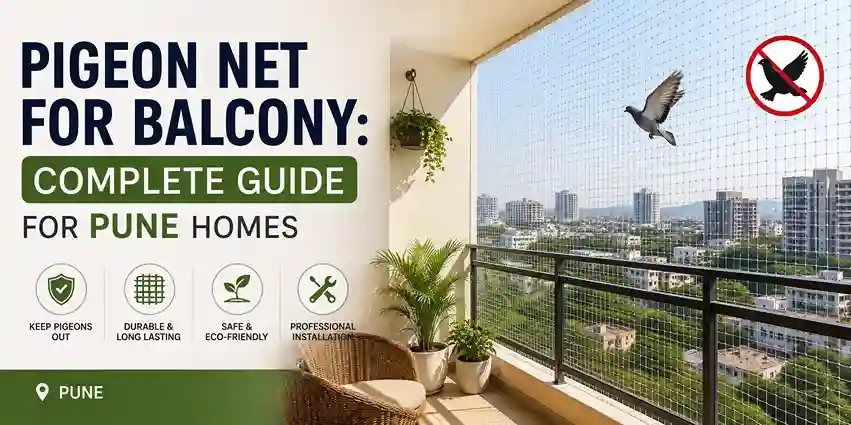
Pigeons can quickly turn an open balcony into a difficult space to maintain. They may perch on railings, build nests in corners and leave droppings around floors, furniture and air-conditioning units. A pigeon net for balcony creates a physical barrier that helps prevent pigeons from entering while keeping the balcony open for normal use. For Pune homes and apartments, the right net, mesh size and installation method can make a significant difference in both protection and long-term durability.
Pigeon nets are a tightly woven mesh, usually made from nylon or polyethylene, that is stretched across balconies, windows, or open terraces to physically block birds from entering. Unlike spikes or reflective deterrents that try to scare pigeons away, a balcony net creates a complete barrier. The bird simply cannot get in, no matter how determined it is.
This kind of bird mesh typically comes in sizes ranging from 3/4 inch to 2 inches. Smaller mesh sizes keep out sparrows and other small birds as well, while larger mesh is usually enough for pigeons alone. Quality nets are UV-stabilized so they don’t degrade quickly under Pune’s strong summer sun, and most are treated to resist tearing, fraying, and knot slippage.
Why Pune Balconies Need a Bird Net
Pune’s mix of high-rise apartments, tree-lined streets, and older independent houses creates ideal pigeon habitat. Balconies and window ledges offer flat, sheltered surfaces that pigeons love to nest on. Once a pair decides your balcony is home, they return again and again, and their droppings are not just unsightly.
Pigeon droppings carry fungal spores that can cause respiratory issues, and accumulated waste corrodes paint, metal railings, and AC units over time. In housing societies across areas like Kharadi, Wakad, and Baner, residents’ welfare associations increasingly ask individual flat owners to install a balcony safety net in Pune buildings, both for hygiene and to avoid disputes with neighbours about droppings falling onto lower floors.
Types of Pigeon Mesh Available
Not all pigeon control net options are the same, and picking the right one depends on your balcony’s shape and how much airflow or visibility you want to retain.
Nylon pigeon net varieties are the most common choice for residential balconies. They’re lightweight, nearly invisible from a distance, and strong enough to withstand years of sun and rain exposure without sagging.
HDPE (high-density polyethylene) nets are thicker and more rugged, often used for larger open terraces or commercial buildings where durability matters more than a discreet appearance.
Knotted versus knotless nets is another distinction worth knowing. Knotted nets are stronger at the joints and better suited for high-wind areas or upper floors, while knotless nets have a smoother, more refined finish that some homeowners prefer aesthetically.
How Pigeon Net Installation Works
A typical pigeon net installation begins with measuring the balcony and checking the available grills, walls, hooks and other fixing points. The net is then cut to the required size and secured around the balcony using suitable hooks, GI wires or perimeter cords.
For most residential balcony net installation jobs, the installer needs to pay particular attention to corners, sliding doors, AC units and other openings where pigeons could enter. The final fitting should cover the intended balcony area properly while maintaining normal airflow and visibility.
Anti Pigeon Net vs Other Balcony Solutions
Compared to pigeon spikes, which only stop birds from perching on a specific ledge, a full anti pigeon net protects the entire balcony space, including the floor, railings, and any items stored there. Compared to invisible grills, which are designed primarily for fall safety, pigeon nets are purpose-built for bird exclusion and tend to be more affordable per square foot. We’ve laid out this comparison in more depth in our guide on bird nets versus invisible grills, if you’re still deciding which one fits your balcony.
Many Pune homeowners combine solutions — using a pigeon control net for open balconies and spikes for exposed AC ledges or narrow sills where a full net isn’t practical.
Pigeon Net Price in Pune: What Affects the Cost
The cost of a pigeon net for balcony installation can vary depending on the size and layout of the balcony, the height of the building, the type of mesh selected and the fixing method required. A compact apartment balcony may require less material and installation work than a large or wraparound balcony with multiple corners and openings.
The condition of the existing grills, walls and fixing points can also affect the installation requirements. Because every balcony is different, an on-site measurement can provide a more accurate estimate than a price based only on photographs.
Maintenance and Lifespan
A good-quality pigeon net for balcony in Pune, when properly installed and maintained, can provide long-term protection. Occasional cleaning to remove dust and cobwebs, along with periodic checks for loosened edges after heavy monsoon winds, can help keep the net in good condition. If a small tear or fixing issue appears, it is worth addressing it promptly rather than waiting for the problem to become larger.
Choosing the Right Installer for Pigeon Net Installation in Pune
Installation quality can affect how effectively a balcony net works over time. When choosing an installer, check the mesh material, fixing method and workmanship warranty. It is also worth confirming whether the team has experience working with different balcony layouts, including sliding grills, corners and curved railings.
Final Thoughts
A pigeon net can be a practical way to protect a Pune balcony from unwanted pigeon entry, nesting and droppings. The right mesh, suitable fixing method and proper installation can help maintain the balcony while preserving normal airflow and visibility.
If you are considering a bird netting service in Pune, you can discuss your balcony requirements and installation options with NetifyBird. For installation enquiries or to arrange a site visit, contact us to discuss your requirements.
Frequently Asked Questions
Pricing varies based on balcony size, floor height, and mesh type, so costs differ from home to home. Most installers offer a free site visit to give an accurate quote rather than estimating from photos alone.
For a standard residential balcony, installation usually takes two to four hours. Larger terraces or balconies with complex grill work, sliding doors, or multiple AC units may take longer.
Nylon pigeon nets work well for most residential balconies since they’re lightweight, discreet, and durable. HDPE nets are thicker and better suited to large open terraces or commercial spaces that need extra ruggedness.
Good quality mesh is thin and largely see-through, so it has minimal impact on airflow, sunlight, or your view. Most homeowners barely notice it once installed.
A properly installed, good quality net typically lasts five to ten years. Small tears can usually be patched, so full replacement is rarely needed within that window if the net is maintained.