Choosing the right bird mesh size is important when you want to prevent birds from entering balconies, windows, ducts, terraces, warehouses, or other open areas. The mesh opening affects which birds can pass through, while the material, strength, UV resistance, and installation quality determine how well the net performs over time.
In Pune, bird-netting providers commonly offer different mesh sizes depending on the location and type of bird problem. Sizes such as 19 mm, 25 mm, 30 mm, 35 mm, 40 mm, and 50 mm may be available, but there is no single mesh size that is suitable for every property.
This guide explains the most commonly discussed sizes and how to choose the right option for your requirement.
What Does Bird Mesh Size Mean?
Bird mesh size refers to the approximate opening between the strands of the net. A smaller opening creates a finer mesh, while a larger opening creates a more open mesh.
For example:
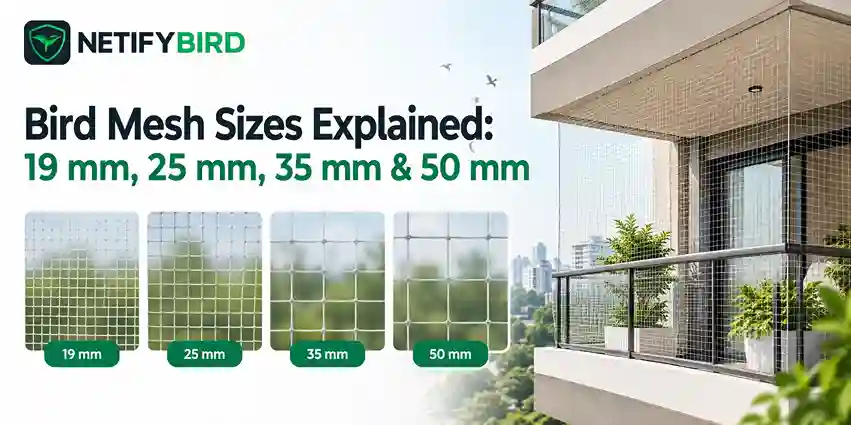
- 19 mm bird netting has relatively small openings.
- 25 mm bird netting provides a common medium-small opening.
- 35 mm bird netting has larger openings.
- 50 mm bird netting provides a more open configuration.
The correct size depends on the bird species, location, purpose of the installation, and the level of exclusion required.
Why Is the Right Bird Mesh Size Important?
The purpose of bird netting is not simply to cover an area. The mesh needs to prevent the target birds from passing through while still being practical for the property.
A suitable bird mesh should consider:
- The size of birds you want to exclude
- Balcony or opening dimensions
- Visibility requirements
- Airflow and natural light
- Exposure to sunlight and rain
- Net material and UV resistance
- Fixing and installation method
A smaller mesh is not automatically stronger or better. The overall quality of the net and installation also matters.
19 mm Bird Netting
19 mm bird netting is a relatively fine mesh option. Smaller openings can be useful where tighter bird exclusion is required.
It may be considered for:
- Areas where smaller birds are a concern
- Smaller openings and gaps
- Residential applications requiring finer mesh
- Situations where preventing smaller birds from entering is important
Because the openings are smaller, 19 mm mesh can provide a more restrictive barrier. However, the final choice should be based on the actual bird problem and site conditions rather than mesh size alone.
25 mm Bird Netting
25 mm bird netting is one of the important sizes to consider for residential and building applications. It can be suitable for balconies and other areas where bird entry needs to be restricted.
It may be used for:
- Residential balconies
- Windows and shafts
- Pigeon-prone areas
- Building openings
- Selected commercial applications
For homeowners looking for bird netting services in Pune, the installer should assess the opening, bird activity, and required protection before recommending the mesh.
30 mm Bird Mesh
30 mm bird mesh falls between the finer and larger mesh options. It may be available for specific applications depending on the manufacturer and supplier.
This size can be considered when a property does not require the finer opening of 19 or 25 mm but still needs controlled bird access.
The suitability depends on the type of birds, location, and installation requirements.
35 mm Bird Netting
35 mm bird netting provides a larger opening compared with 19 mm and 25 mm mesh.
It can be considered for selected applications where a relatively open mesh is acceptable. Before choosing 35 mm, however, it is important to identify the smallest bird that needs to be excluded.
For residential balconies with smaller birds entering the area, a finer mesh may be more appropriate.
40 mm Bird Mesh
40 mm bird mesh provides a more open configuration and may be suitable for larger spaces or applications where extremely fine exclusion is not required.
It can be considered for:
- Large open areas
- Commercial properties
- Warehouses
- Agricultural applications
- Selected industrial locations
The required mesh should always be determined according to the actual bird activity and the purpose of the installation.
50 mm Bird Netting
50 mm bird netting has larger openings and is generally considered for applications where a more open barrier is appropriate.
It may be used for:
- Large areas
- Selected commercial applications
- Industrial or agricultural spaces
- Areas where larger birds are the primary concern
However, 50 mm should not automatically be treated as the correct size simply because the target bird is a pigeon. The application, opening, installation design, and required level of exclusion all need to be considered.
Bird Mesh Size Quick Comparison
| Mesh Size | Opening | Typical Consideration |
| 19 mm | Fine | Smaller openings and tighter exclusion |
| 25 mm | Small-medium | Residential and selected balcony applications |
| 30 mm | Medium | Specific applications depending on requirement |
| 35 mm | Medium-large | Selected open areas |
| 40 mm | Large | Commercial, agricultural and larger areas |
| 50 mm | Larger | Large/open applications and selected bird-control requirements |
These are general considerations rather than fixed rules. Different manufacturers may offer different specifications and construction.
Which Bird Mesh Size Is Commonly Used in Pune?
There is no single standard bird mesh size used across Pune. The appropriate opening depends on the property type, target birds, and purpose of the installation.
Commonly available options include 19 mm, 25 mm, 30 mm, 40 mm, and 50 mm. Finer mesh can be considered where smaller openings need tighter exclusion, while larger mesh may be suitable for spacious commercial, agricultural, or industrial areas.
When selecting mesh in Pune, consider:
- Target bird species
- Area and opening size
- Residential or commercial application
- Required visibility and airflow
- Sun and monsoon exposure
- Net material and installation quality
So, the most suitable mesh should be selected based on the specific application, rather than choosing a size simply because it is commonly available.
What Bird Mesh Size Is Suitable for a Pune Balcony?
For a residential balcony, 25 mm bird mesh can be a suitable option in many pigeon-control applications. However, the ideal size depends on the balcony design and the birds entering the space.
If smaller birds are also a concern, a finer mesh such as 19 mm may be considered. The installer should also check the balcony’s corners, gaps, pipes, and fixing points to ensure the net provides complete coverage.
A professional assessment can help determine whether 19 mm, 25 mm, or another size is more appropriate for the balcony. Homeowners comparing different balcony protection options can also explore bird netting for balconies alongside the mesh-size requirements.
For more information about local applications, you can explore bird netting in Pune and compare the available protection options.
Pigeon Mesh: What Should You Look For?
When selecting pigeon mesh, don’t focus only on the mesh opening.
Look at the complete product and installation, including:
- UV-stabilized material
- Strong and consistent netting
- Suitable mesh opening
- Proper hooks and fixing points
- Correct tension
- Resistance to outdoor conditions
- Neat installation around corners and edges
A good-quality mesh that is poorly installed can still leave gaps through which birds may enter.
Does Smaller Mesh Mean Better Protection?
Not necessarily.
A smaller opening can provide tighter exclusion, but it may not always be necessary for every property. Mesh selection should balance protection, visibility, airflow, appearance, and application requirements.
For example, choosing an extremely fine mesh for a large industrial area may not provide any practical advantage if a larger opening is sufficient for the target birds.
The objective is to select the right mesh, not simply the smallest mesh.
Mesh Size vs Net Strength
Mesh size and net strength are two different things.
A smaller mesh does not automatically mean the net is stronger. Strength can depend on:
- Material quality
- Twine thickness
- Knotless or knotted construction
- UV stabilization
- Manufacturing quality
- Installation tension
- Fixing system
For outdoor installations in Pune, UV and weather resistance are particularly important because the net may remain exposed to strong sunlight and seasonal monsoon conditions.
Does Bird Mesh Affect Visibility?
Yes. Mesh opening and twine construction can influence how visible the net appears.
Fine mesh may have more strands within the same area, while larger mesh can appear more open. However, actual visibility also depends on the colour, material, thickness, lighting, viewing distance, and installation angle.
For balconies, homeowners often want a solution that provides bird protection without significantly affecting the appearance of the space. This is why choosing the appropriate mesh and installing it neatly are both important.
Common Mistakes When Choosing Bird Mesh
Avoid these common mistakes:
Choosing Only by Price
The cheapest net may not provide the required durability or UV resistance.
Selecting Mesh Without Identifying the Bird
Different bird sizes may require different levels of exclusion.
Assuming Smaller Is Always Better
A finer mesh is not automatically the best solution for every location.
Ignoring Installation Quality
Gaps around walls, corners, pipes, or fixing points can allow birds to enter even when the mesh itself is suitable.
Ignoring Weather Exposure
Outdoor netting should be suitable for prolonged exposure to sunlight and rain.
How to Choose the Right Bird Mesh
Before installation, consider these five questions:
1. Which birds are entering the area?
Identify the main bird problem.
2. Where will the mesh be installed?
A balcony, shaft, terrace, warehouse, and industrial area may require different solutions.
3. What opening size is appropriate?
Compare available options such as 19 mm, 25 mm, 30 mm, 35 mm, 40 mm, and 50 mm.
4. What material is being used?
For outdoor use, UV and weather resistance are important.
5. How will the net be fixed?
Strong and properly positioned fixing points are essential for long-term performance.
Bird Mesh for Homes, Commercial Buildings and Industrial Areas
Bird netting is used across different types of properties.
For homes, balconies, windows, ducts, and shafts are common areas where bird entry can become a problem.
For commercial properties, open structures, service areas, warehouses, and building openings may require bird exclusion.
For industrial locations, the focus may be on protecting larger spaces, equipment, storage areas, and production environments.
The mesh size should therefore be selected according to the specific application instead of using one standard size everywhere.
Need Help Choosing Bird Netting in Pune?
Selecting the correct bird mesh is only one part of an effective bird-control installation. Material quality, mesh construction, fixing points, tension, and site conditions also influence the final result.
If you are unsure whether 19 mm, 25 mm, 35 mm, 40 mm, or 50 mm is suitable for your property, it is better to assess the site before installation.
You can contact our bird-netting team to discuss the requirements of your balcony, residential property, commercial space, or larger installation.
Final Takeaway
There is no universal bird mesh size that works for every property. Sizes such as 19 mm, 25 mm, 30 mm, 35 mm, 40 mm, and 50 mm are used for different applications depending on the required level of exclusion.
For residential balconies in Pune, 25 mm may be an option for certain bird-control requirements, while finer or larger mesh may be more appropriate depending on the situation.
The best approach is to consider the target birds, opening size, material quality, UV resistance, visibility, and installation method together. Choosing the right combination will provide more practical and reliable long-term bird protection.
Frequently Asked Questions
Start by identifying the smallest bird you want to exclude. Then consider the location, opening size, balcony or building design, and required level of protection. Smaller mesh openings are generally considered when smaller birds need to be restricted, while larger openings may be suitable for larger birds and larger structures.
Yes, bird mesh size can affect airflow and the amount of light passing through the net, although the effect also depends on twine thickness, mesh construction, colour and installation. In general, a more open mesh allows more unobstructed airflow and light, while finer mesh provides more coverage.
Yes. Bird netting should be properly tensioned and securely fixed rather than left loose or sagging. Correct installation improves the appearance of the net and helps prevent gaps or sections where birds may gain access.
For outdoor applications, UV-stabilised HDPE bird netting is a commonly used option because it is designed for exposure to sunlight and weather. Longevity also depends on the quality of the net, twine construction, installation and environmental conditions.
There is no single standard size of bird wire mesh. Bird mesh is available in different opening sizes depending on the manufacturer and application. Common commercial options can include approximately 19 mm, 25 mm, 30 mm, 40 mm and 50 mm, with other sizes also available.
100 mesh is finer than 40 mesh when the term “mesh” is being used in the conventional wire-mesh sense, because it indicates more openings per unit length. However, this terminology is different from bird-netting measurements such as 19 mm, 25 mm or 50 mm, which normally refer to the physical opening size. Always check the manufacturer’s actual specifications before comparing products.
25mm bird netting can be suitable for some balconies, particularly where the target bird and required exclusion level match that opening. However, the correct mesh should be selected after considering the bird species, balcony design, access points and installation requirements.